Showing posts with label olympia. Show all posts

Wednesday, June 25, 2014

An Unconventional Typewriter Day

Unconventional, because I had the day off! I spent little of the actual day typing as we're entertaining company, and with all due respect to Mr. Sholes, I didn't want to spend it all in front of the keys. I'm looking forward to catching up on everyone's creative endeavors.

As for me, I delved back into colorcasting, this time using crayons on some erasable onionskin that I picked up, thinking that the thinner paper and the special coating (?) might make a more carbon-paper-like surface. In the end, I prepared four sheets with alternating stripes of colors, and then used each to type something "conventional": a few lines of the exploits of the Quick Brown Fox, a thank-you note to Mr. Sholes, a shout out to World Typewriter Day, and the reminder to all Good Men that Now Is The Time.

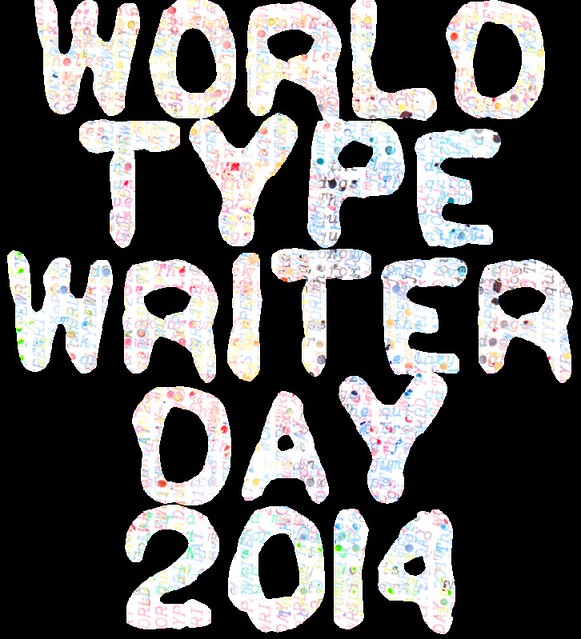
Scanned and placed inside the letterforms of Richard Polt's Sholes & Glidden font, itself a scanned piece made from the handiwork of a far more famous and literary Clemens...


Typewriter Day 2014 word collage

Only too late did I realize how well the lighter wax would work on darker paper: maybe next year!

Using the thinner paper as a base layer for the wax worked well, and I turned the touch control on the typewriter all the way down to the lightest touch. Lots of punch-outs on the closed letters, as you would expect, so another colorcasting lesson was learned: always use an open-bottom typewriter! My table was covered in colorful, waxy confetti when all was done.

Thursday, May 22, 2014

Reflexes, Resonance, and Focusing on Infinity

Focus on infinity
See note for photo pedants, below

20140522 typecast pt1
* GAS = Gear Acquisition Syndrome, a plague of the camera enthusiast

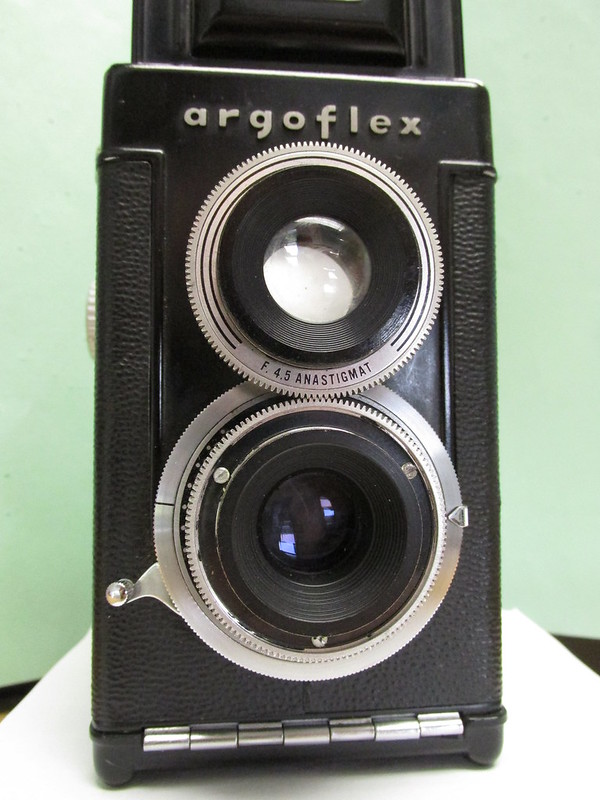
Argoflex EF

20140522 typecast pt2

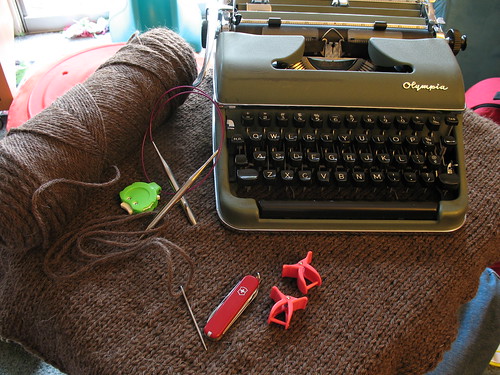
It's been far too long since I pulled out a typewriter and whipped up a typecast. I hope not to stray too far from what I consider to be the core act of a Typospherian. This was banged out on the first machine I had at hand, a locally sourced Olympia SM3. It's good to see that I have not forgotten how to make typos, though all the shadowing does tell me that I'm slow to get my hands out of the way of the keys. "Argus" is the camera brand, not "Argo" as my brain insisted. Other typo corrections are left as an exercise to the reader.

I see many of the blogs in the 'sphere are turning cameraward now. Maybe it's just because summer is approaching here in the U.S., and so one's thoughts turn naturally towards being in a dark room splashing around in cool water. The natural pungentness of the homebrew Caffenol-C developer does mean, though, that your dark room should be well-ventilated. (And while we're on the subject, ye gods do my kids look little in those old photos. Five years!)

Other photo bloggers: what are you using for fixer? Seems to me that was the only part of the process where I had to "go commercial" and just used a fixer concentrate. When that finally ran out, I set everything on the shelf again, and then evidently got busy for half a decade.

Film really is tremendous fun, and black-and-white developing is a large part of that. It's alchemy, pure and simple, turning light and microscopic silver particles into art with nothing more than coffee and soap.

The Argoflex EF (says the Internet) is a metal-bodied version of the earlier Bakelite model E and some variants. It's pretty heavy, reminiscent of the Argus C3 "brick" camera that shares the same simplicity and meshed-gear design. It's a basic design, compared to the far fiddlier -- and honestly, much nicer -- Rolleiflex cameras that I inherited from my late grandfather. I would not be afraid to take the Argoflex out to the beach, for example. It does take 620 film, but true to the Typospherian spirit, modern 120 film can be wound onto old 620 spools to fit.


Note for photo pedants: yes, I know this is not how one technically uses the infinity mark on the lens. Although this may be how one sets it for getting the focus coupling sorted out.

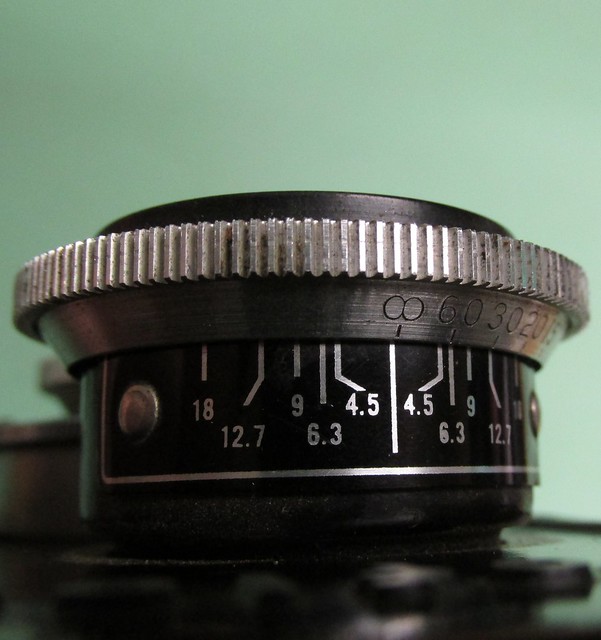
For those not in the know, you line up the marks on the lenses with the setting of the aperture -- the opening -- to find out the depth-of-field of your photo. Closing the aperture into a small opening allows a broad depth-of-field, or basically a photo that's in focus for a much of the distance (think landscape shots.) For sweet "bokeh" effects or to bring one area of the picture into focus, you open up the aperture and line up the marks accordingly. Aperture settings are marked in pairs on manual focus lenses. On this camera, the aperture settings are:

18 12.7 9 6.3 4.5 | 4.5 6.3 9 12.7 18

If I were set up for a real photo, that infinity mark should be lined up over one of these settings. For philosophical reasons and because the light was better :-) I put the infinity mark at the central line.

Saturday, August 3, 2013

Fugue (For Marilyn and Dolly)

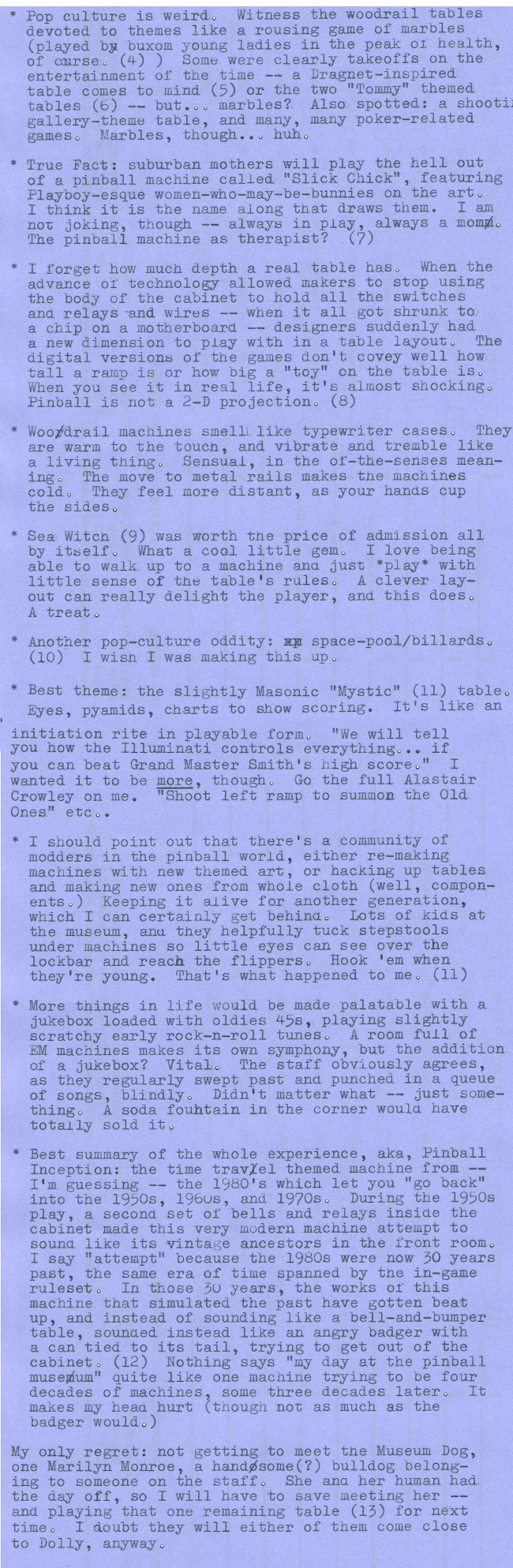
This typecast is web-enhanced for your convenience: see the bottom of the page for end-notes and links.

typecast 20130803 pg 1

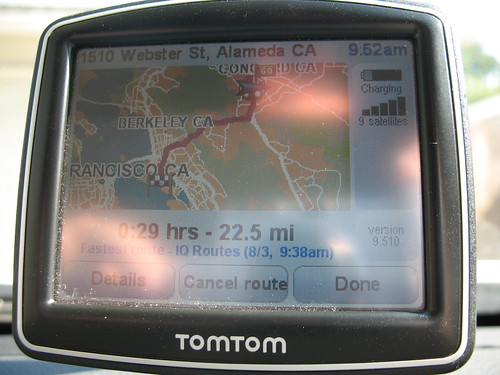
GPS to Pinball Museum

typecast 20130803 pg 2

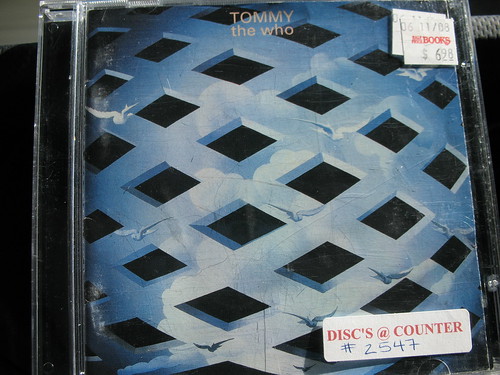
The Who's "Tommy"

typecast 20130803 pg 3

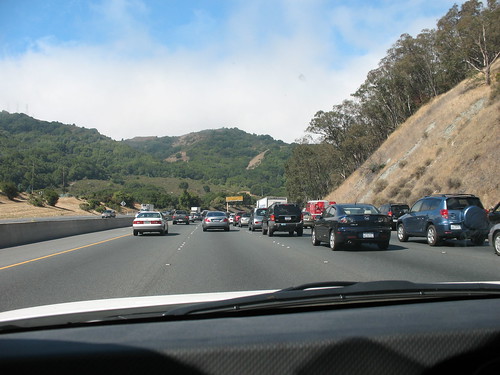
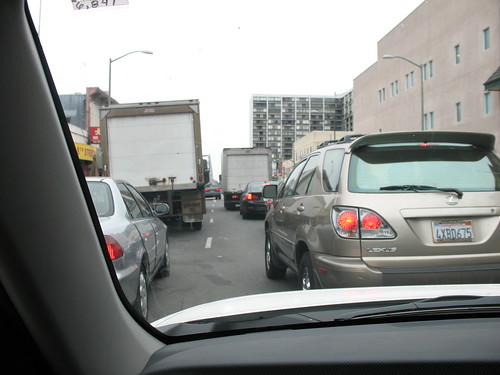
Cadecott tunnel traffic

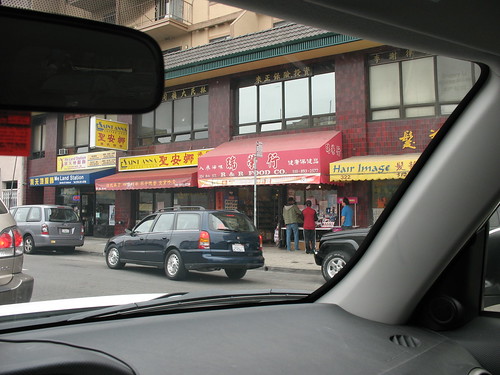
Chinatown, Oakland

Chinatown, Oakland -- deliveries

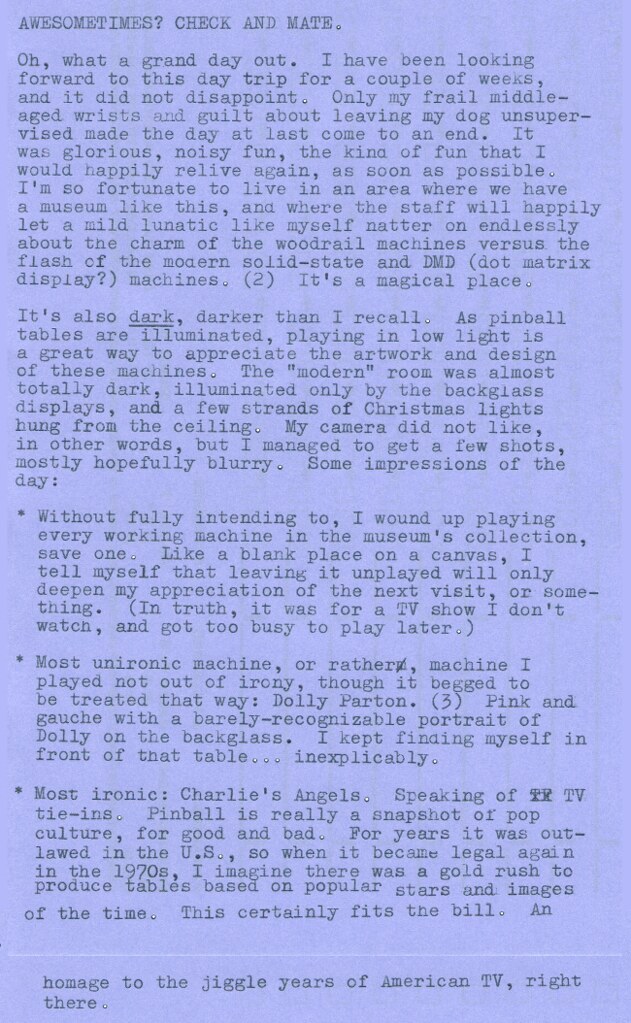
typecast 20130803 pg 4
* "hopelessly blurry," not "hopefully blurry"

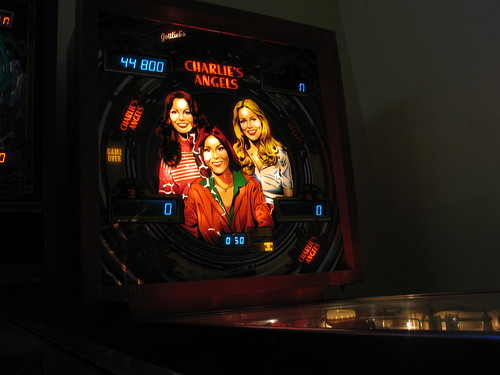
Charlie's Angels pinball backglass

typecast 20130803 pg 5

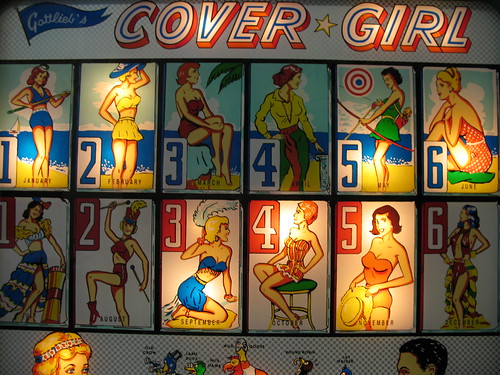
Cover Girl pinball backglass

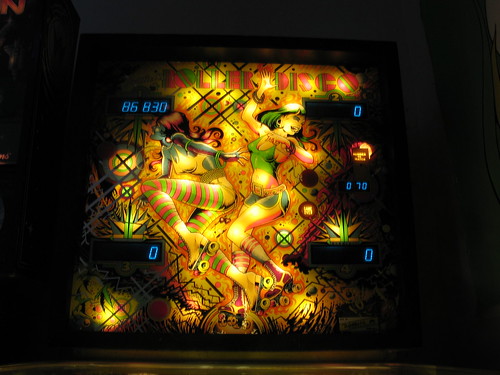
Roller Disco pinball backglass

typecast 20130803 pg 6


End-Notes:

  1. "Tommy" by The Who, in case you're not familiar. I mean, what else would you listen to for a trip to a pinball place? Proof that it was kismet: "Pinball Wizard" started up just as I got into a parking spot. Half the album for the drive in, half for the drive out. That's how you know when something is Meant To Be.
  2. You can roughly lump machines around how they display scores. Some of the very early machines just used lamps behind painted numbers, making the score an integral part of the artwork. Later machines used reels with numbers on them, and then segment displays (like a digital watch) and then ultimately a grid of pixels, which I think are actually neon, not LED, though I would imagine the technology of LEDs has improved enough to make those viable, too. I'm not fully "up" on the latest play technology. I do know that one of the last acts of Williams Pinball (before folding) was the creation of a platform called "Pinball 2000" which uses a very old optical trick known as Pepper's Ghost to appear to project a computer display on or over the playfield. They have one of these at PPM, but I find the display distracting -- like trying to play golf and watch TV at the same time. Some things were not meant to be. I think modern makers are going back to having just light displays on the table, and saving the fancy tech for the backglass, which is where you want it -- to attract new players and their loose change.
  3. Damn, that was a long end-note. Dolly Parton, via the Internet Pinball Database. (IPDB.org) The "backglass" picture gives you some idea of the taste level of this machine.
  4. Marble Queen, and it's just as unbelievable in person.
  5. Dragonette, showing that it's not just Chinese knockoffs that have cornered the market on sound-alike names. Our fair damsel is tied to a chair (of course!) and being given the third degree by a Sherlockian-type character. Also unbelievable.
  6. Captain Fantastic and Wizard! Wait, didn''t Ann-Margret play his mother? Oedipus! may have been a horrible name for a pinball.
  7. Slick Chick is irresistible to the ladies. Check out the almost-Bugs-Bunny on the lower playfield.
  8. Real example: I have Funhouse in various electronic forms. It features a ventriloquist's dummy on the table. Well, just the head. (Those of you with clown/dummy aversions should skip the rest of this note.) It's called "Rudy," for what it's worth, and Rudy heckles you and factors in to some play modes. What you miss on a TV or tablet game, though, is that Rudy is big. Like, real-dummy's-head big. It's like a child's head is stuck in the machine... and the eyes move. You miss all of this nightmare-fuel on recreated versions. Also, PPM's Rudy has a broken eye, so he's slightly cross-eyed all the time. More funny than scary. Mostly.
  9. Seawitch, a one-word name, not two as I have it. A fine example of how mixing up the playfield can make a novel game. Boy, is this one fun.
  10. Laser Cue. Because ROBOTS AND LASERS THAT'S WHY.
  11. Mystic. The eye and pyramid on the backglass are photo-realistic, which is even more unnerving given the normal cartoony illustrations of the table art.
  12. Second footnote #11... The first real pinball experience I can recall is Haunted House which I blogged about indirectly in the very early days of Clickthing.  It may not have been my first ever machine, but it's the one that sticks with me in my memory as being Completely and Totally Awesome. Probably doesn't hurt that I was about 11 or 12 at the time I played it, maybe younger. That table is regularly asked for in app form by fans who had the same near-religious experience as I did: some even as adults, I gather. It is reportedly an utter nightmare to maintain, with a complex electrical system that required two sets of circuits (and hence flipper buttons) and has ton of features and parts that are hard to source, access, and repair. Supposedly, you can buy one of these, set it up, and just listen to it fall apart. I may be making that up. Maybe. During my formative teen years on summer vacations I played games like Cyclone and Pinbot and High Speed, all of which I played today for that nostalgia boost ("I can't believe it's been 25 years" etc.) but nothing can take the place of that first pin.
  13. Time Machine. No mention of badgers on IPDB, though.
  14. CSI, for what it's worth. Far better: playing Doctor Who multiple times, to retroactively make my nerdy Whovian teen self happy.


Hey Teeritz! The machine you're thinking about is Hercules, which is a jumbo-sized machine that plays using a pool ball instead of a steel ball. If you like slow, prone-to-break machines, you'll love Hercules! Proof that novelty alone doesn't make a good table.

Black Knight is a classic table, and should never be uttered in the same sentence as Hercules. I have played the former in real life, and once was enough. The latter was out of commission at PPM, so I hope to get a shot at it next time.

Those of you with some sort of electronic computing technology and a yen for the silver ball should run-don't-walk to The Pinball Arcade. They're doing an excellent job of digitizing these machines, even if they don't manage the life-sized creepy talking doll heads. Can't have it all, I guess.

Friday, August 2, 2013

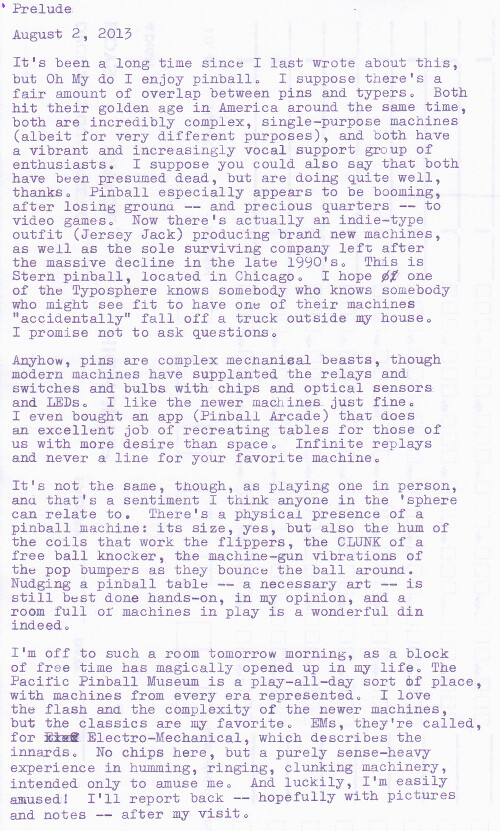
Prelude

typecast 20130802

I suppose there's the easy comparison with both machines containing bells, too, although most mechanical noisemakers except the extra-ball/replay knocker have been replaced by stereo sound. Nobody dares touch that knock, though. It's just an electromagnet that smacks a piece of wood in the cabinet, essentially, but it's one of those funny little holdovers form the past -- like QWERTY? -- that can't be changed, at least not easily. To get rid of that component is to lose some of the pinball-nature of the table.

PPM has a website with hours and photos, in case you ever find yourself in the Bay Area and need an afternoon of amusement. I bet they'd have no problem staging a type-in.

Typed on an Olympia SM3

Wednesday?

Saturday, July 27, 2013

Wednesday?

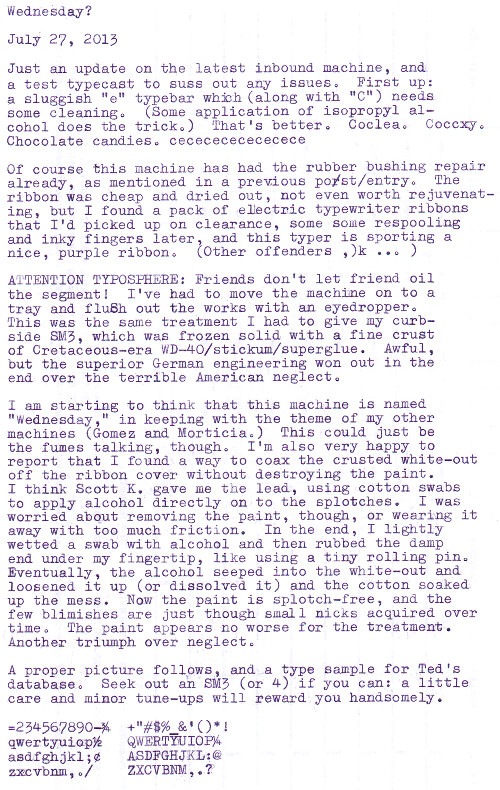
typecast 20130727

"Coccyx" being the word I was trying to spell when I had the problematic "C" key in there. I'm not sure what "coccxy" is, but it sounds suspect. This is the first time I've used a ribbon beyond the standard bi-color or all-black varieties. It's subtle, but I like it. The purple seems very Gothic to me, appropriate for Wednesday Addams, who was something of the proto-Goth.

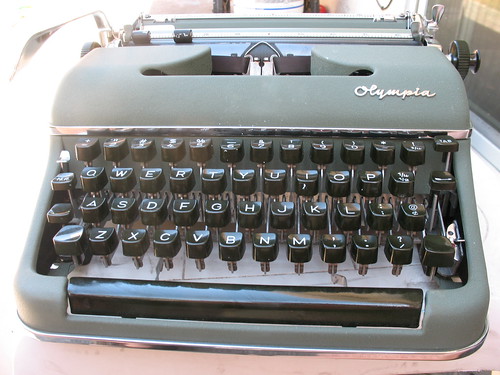
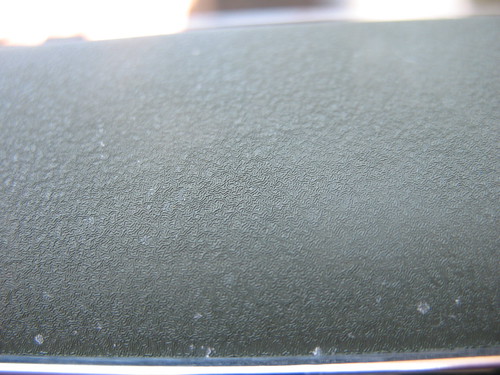
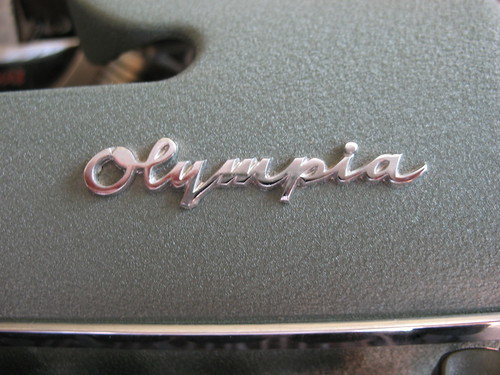
Here's the machine, with a zoomed in view of the cleaned cover.

Wednesday?

I can only see traces of the original mess, near the chrome trim. A few more minutes with the cotton swabs and alcohol ought to take care of that.

Crinkle paint, sans white-out


In typewriter adoption news, the boxes are in! Staples chose not to inform me of this fact, but I now should have enough supplies to get the first wave of adopted machines out to their new homes. Thanks again for your patience: I'll email folks directly if they're on the list for a typer.

Friday, July 19, 2013

Replacement

Had it been any other machine, I would have opted either to leave it behind, or put it directly up for adoption...
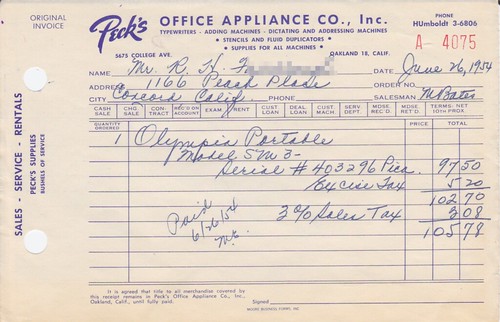
Laptop money, c. 1954

But you know, I have this weakness... for all things Olympia.
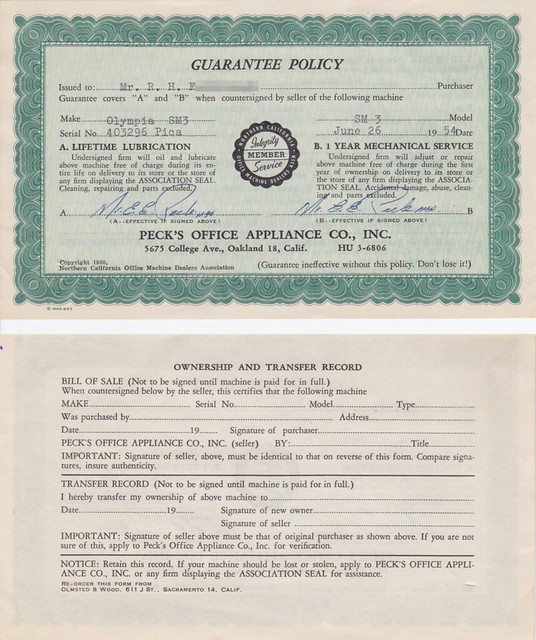
Lifetime lubrication

Especially SM3s, and extra-especially ones with a Pica typeface. I find the bigger face easier to read and edit, and it seems to scan better for me at NaNoWriMo time.

The tweedy case threw me off at first, and it was locked, so if nothing else, I had to solve the mystery. I gathered up my tiny collection of case keys (two) and hoped that one would fit so I could solve The Secret of the Anonymous Case at Goodwill. Evidently, junior sleuths the world over have nothing to fear, as closer inspection the next day revealed that someone had masking-taped the manual to the outside of the case. Tucked inside the manual, though, were the added bits of ephemeral joy scanned above: the original invoice, and the lifetime lubrication and oiling certificate, sealed by the Northern California Office Machine Dealers Association. As soon as I build that time machine, I plan to dial it back and check out one of their regional meetings.

Peck's Office Appliance Company left a fine sticker inside the case which I'll have to photograph and include here. It's swag, to quote my teenager. The former site of Peck's appears to be smack in the middle of the BART line's Rockridge station, the San Francisco Bay Area Rapid Transit system: an electric elevated/subway train that is one of the major transit options around here. They're currently having a labor dispute, and we suffered from a strike back at the beginning of the summer that led to serious traffic headaches. They're still battling it out, leaving everyone scrambling for alternate ways to get around.


View Larger Map

That's something we don't really think about as commuters: the homes and businesses that were replaced by our transit system. It really only comes to mind in a few places along the line, as the tracks skirt close to a crumbling property or appears in the narrow buffer between streets. Rockridge was one of the stops on the line that I rode for years in and out of San Francisco. BART opened in the 1970s, and was a fixture out in the suburbs by the time I moved to California twenty-five or so years later. Rockridge station opened up in 1973, says Wikipedia, just nineteen years after this typewriter was sold. I don't know how long Peck's held on after that, but I don't think I'll be able to cash in on that "Lifetime Lubrication" offer any time soon.

Like all good Olys, this one needs the standard bushing replacement surgery. It's no big deal: I'm familiar with the process now, and know exactly where to go in the hardware store for the replacement parts.
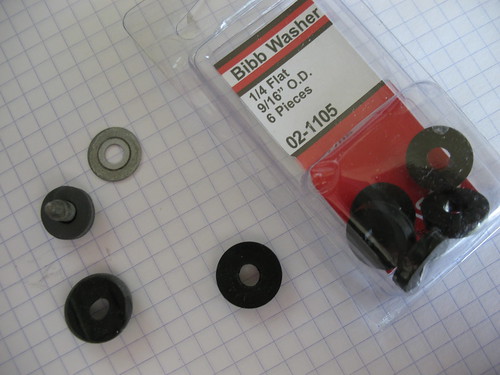
Broken typewriter? Call a plumber

Replacing a set of crushed and fossilized bushings hardly warrants a mention...
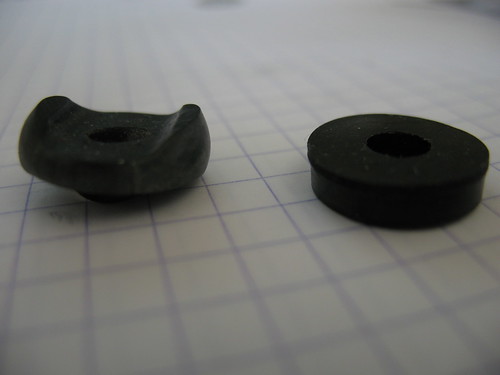
Smushed

What this does mean, though, is that one of the other machines is now up for adoption. After some soul-searching, I've put up a Smith-Corona Sterling that's basically sat idle since it came in on a swap from Olivander of Machines of Loving Grace fame. It, along with the other machines, are up on a new dedicated "adoption" page. This might be the best way for me to deal with the thrill of the hunt, without the space considerations of the "trophies": find 'em, fix em, find new homes for 'em. Sometimes replacement is the only way.

UPDATE: the lighting couldn't be much worse for these. Anyone know a secret for getting White-Out out of crinkle paint? (At least I hope it's White-Out) 
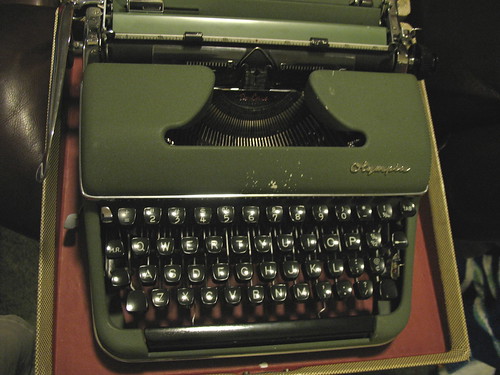
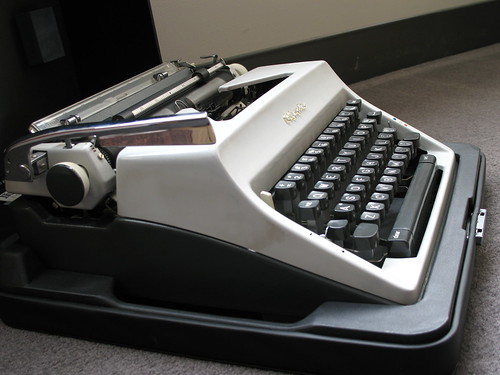
Olympia SM3, c.1954

Ted's database says 1953 for serial number 403296. Sounds about right to me.
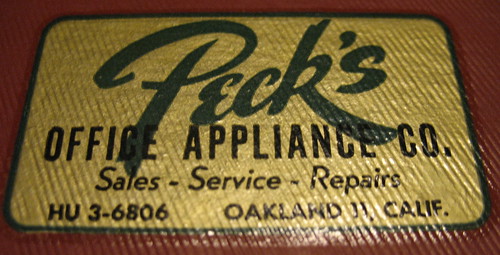
Peck's Sticker

Golden label with green lettering, just about the same as the paint color. Stylin'! I wouldn't mind this being on the machine itself, but it's discreetly tucked inside the case lid.

Tuesday, April 2, 2013

Saturday, March 23, 2013

Typespotting: Olympia International Arabic Electric

Apologies for the atrocious photo quality, but spotted this monster today -- an electric Olympia standard model (SG... something?) with an Arabic keyboard. Very neat! Even has the dual cloth- and carbon-ribbon system inside.


Yes, Ted, I did get the serial number, too. :-) Don't know the age or model, but if I had to guess, I'd say a 1970's electrified SG3, just based on the body style, the logo, and the paper-injector lever (cut out of the bottom photo.)

Sunday, November 11, 2012

Auditions: A Dark Horse to the Rescue

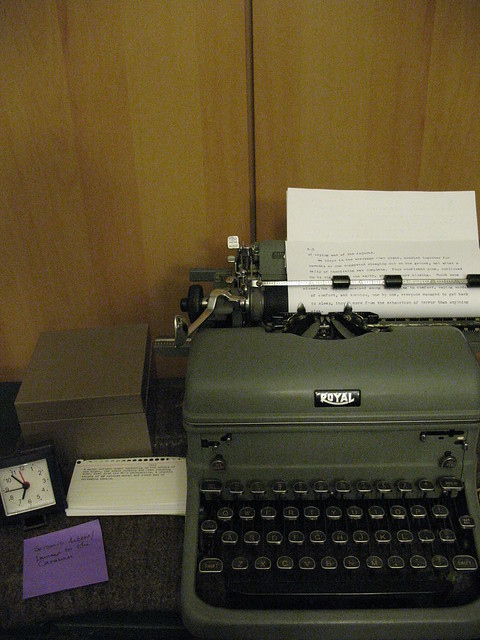
Due to the fact that my typing station is set up in our family room, my Nanowrimo typing time is limited to those few hours when people aren't trying to watch TV, or have a conversation, or basically do anything over the unholy din of me at the Beast: the Royal KMG tucked in its November writing spot behind the sofa.

This is what morning looks like

Such a situation arrived yesterday. My youngest was staying in, recovering from one of those spontaneous fevers that children seem to develop. Using the Beast is out of the question when a kid's in the room, much less a sick kid propped up on pillows watching her way through our DVD collection. And all my auditioned machines are at my office. Drat!

I could have grabbed any of the spares here at home, but since I discovered how well OnlineOCR works for me this year, I'm hesitant to use a machine with irregular type, as many of them do. And of course, being a sort-of collector means that you get to play favorites.

This is when I remembered Gomez, my same-era SM3, who was tucked away on the floor of the coat closet.

Typing pad project: the raw materials

I grabbed an old cafeteria tray we have at home, Gomez, and paper, and headed off into the bedroom to work. An emergency type-cleaning with some alcohol and an old toothbrush was all it needed to get the slugs shining. Gomez types at the odd-sized 11 cpi size (picalite?) so every page from that machine is like one and a half from the Beast, and over the course of the day, I ducked in to try to knock out a page when I wasn't swapping DVDs or getting beverage refills.

Gomez was a well-loved machine before I got him from Freecycle. I'd forgotten about the stray marker scribbles on his side and the mysterious sticky something (gum, I hope) on the front corner of his frame. The ribbon cover paint is worn away from being scraped by the return lever, and he desperately needed the gasket-replacement repair.

His looks may not be much, but oh! I am a stalwart lover of these Teutonic marvels. Gomez rescued the day's writing... though not the plot. Nothing in my collection can manage that.

Thursday, September 27, 2012

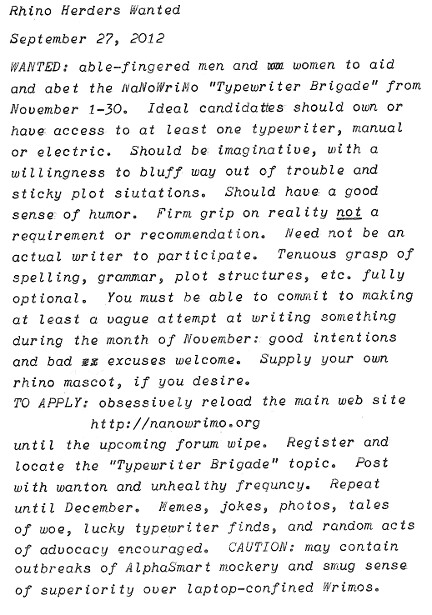
Rhino Herders Wanted

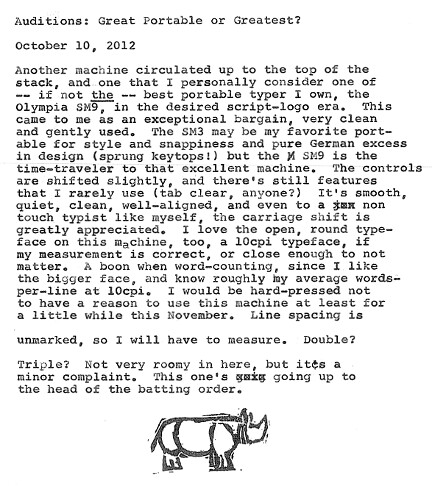
November dreaming

20120927 typecast

Hey look! I'm already practicing my crummy spelling and grammar! Avert your eyes and:
  1. Go register at the NaNoWriMo site
  2. Check out the 2011 Brigade Topic (until the forum wipe)
  3. Sure, I'll be your buddy

Typed (with an assist) on an italic-face Olympia SM3

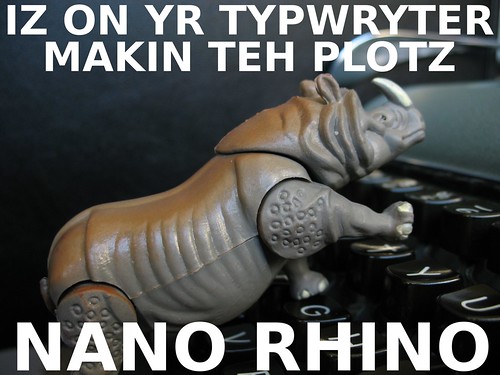
Nano Rhino

Thursday, July 12, 2012

The Magic Touch

typecast 20120712

Safe travels, old friend. We typed many a word together!

Transcribing

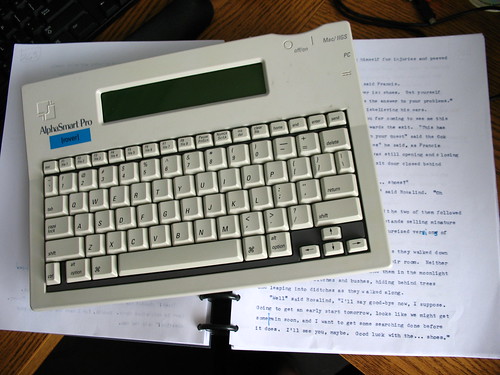
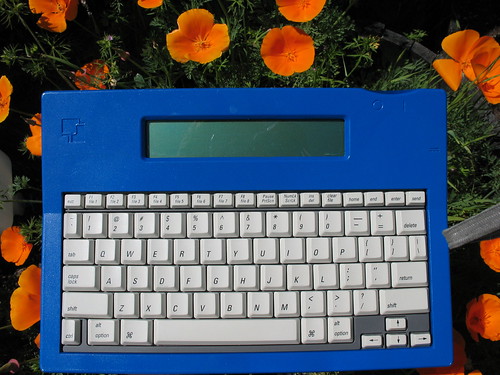
A tip to any other AlphaSmart-hackers out there... Kryon plastic paint does all right, but it's still not optimal for this application. Very soon after this picture was taken, areas of paint started to rub off from the frequent contact with my hands. Either prime first and/or sand the plastic and/or use another product (like vinyl dye?) to personalize your Alphie. I'm leaving the new one alone.

AlphaSmart Pro, with poppies and camera strap

What brought this sudden turnabout on was the fact that I won* Camp Nano this summer, by pulling a Kobayashi Maru and declaring that "winning" meant "transcribing my already-written 2011 NaNoWriMo draft The Ballad of Congo Willy." I'd done some small-scale tests of the Dragon Dictate software before with some success, so it seemed reasonable for me to read the draft into the computer, tackling each day's worth of typing into a day's worth of speaking.

Sadly, me reading my novel aloud into perfectly-digitized prose was not in the cards for a number of reasons:
  1. It annoyed my wife for a month, since I was in front of the main computer all the time, which meant I was sitting in the kitchen, shushing people as they tried to go about the business of cooking, cleaning, or just walking through the house.
  2. The draft is very rough in spots, and I wasn't sure what to do about it. Revising as you talk isn't an option, honestly. I eventually gave up trying to fix as I talked, and just read everything.
  3. Horrible, horrible performance anxiety, if one can get such a thing sitting in one's own kitchen, reading a nasty draft into the computer. I, apparently, can.
Basically, I rushed through the reading so I could be done quickly, and so I could squeeze it in while I knew I'd be alone and not mortified that someone might overhear parts of the draft-in-process. That, coupled with my already shady diction, lead to winning sentences like this one appearing on screen:
For just a 2nd I caught a glimpse of someone else, dressed in gray, questionable or small tables traces of Honda wafted through the air.
What is this I don't even.

Worse yet, I realized that I want the main story to be written in present tense, not past tense. That means a stem-to-stern rewrite. And that means digging out the Pro... or choosing a replacement. And as much as I mockingly bad-mouth AlphaSmarts during NaNoWriMo, they have the same dead-simple operation and no-distraction philosophy as the typewriter. (And the 700 hour battery life kicks complete butt, too.)

Most importantly, Mrs. Clickthing approved of the trade-in deal (she who scored our trio of AlphaSmart Pros in the first place.) It's not Another Damn Typewriter coming into our house, after all, despite her enabling ways.

We'll see if the Neo 2 has the magic touch.