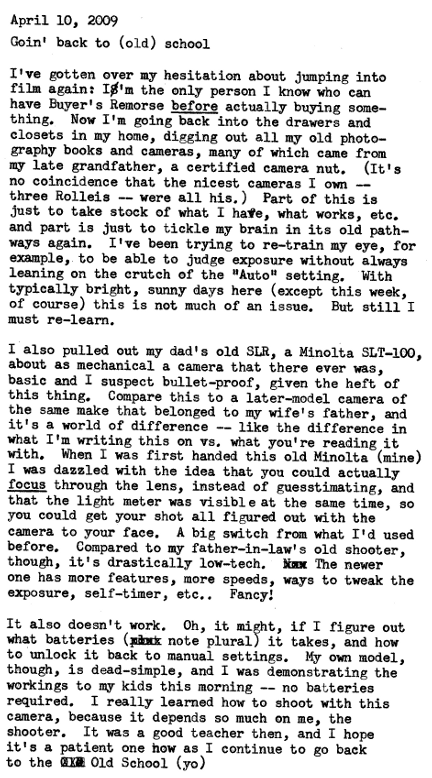
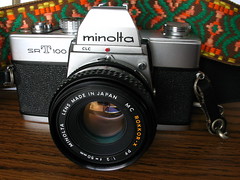
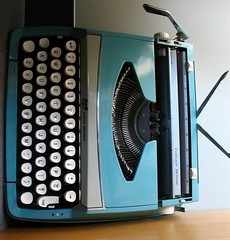
I'm justifying this as a blogiversary present to myself, the first camera I actually remember owning and using, a Kodak Instamatic X-15. Mine (as a child) was quite possibly bought for me brand-new, given the dates when this thing was made (I was about 5 or 6.) Like finding an old favorite toy in the attic, finding this on the thrift store shelf with a box and a half of unused Magicubes was a complete nostalgia trip. The other typewriters and cameras are a sort of artificial memory I'm wrapping myself in -- I obviously never really used a typewriter or a fountain pen or a mechanical watch for day-to-day life, but that old Instamatic went with me on camping trips and visits to the grandparents. The loud ratcheting sound of the winding lever put me right back in plaid Garanimal flare pants (you whippersnappers can look that one up on your Google thingus.)
Instamatics were cheap plastic affairs, semi-light-tight since they used the 126 film format, a drop-in plastic cartridge that contained the film, rolled with a thick backing paper so you could see the frame numbers through a little window on the back of the camera. Perfect for a kid. And perfect for a big kid, too, who found directions on how to convert an instamatic to 135 film (better know as 35mm.) My conversion was even simpler, just by notching the top of the film spool and then covering the numerous gaps in the camera with black sticky-back craft foam. I ran a roll through this weekend, and am going to get the negatives done at Walgreens over lunch.
Post-lunch update:
Factoring in the amount of hacking I had to do to get this image digitized, the results are not bad.
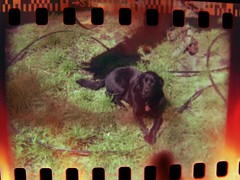
(photo tinkered with since my yard is not blue-green)
Let's consider:
- Crappy camera to start with
- Using film twice as fast as recommended for the camera
- Using film not at all made for the camera
- Hand-held photograph of the negative as pressed against my (tinted) office window
- Hand-inverting the image from the negative