Showing posts with label pen review. Show all posts

Thursday, April 28, 2016

Pen Review: Lamy 2000

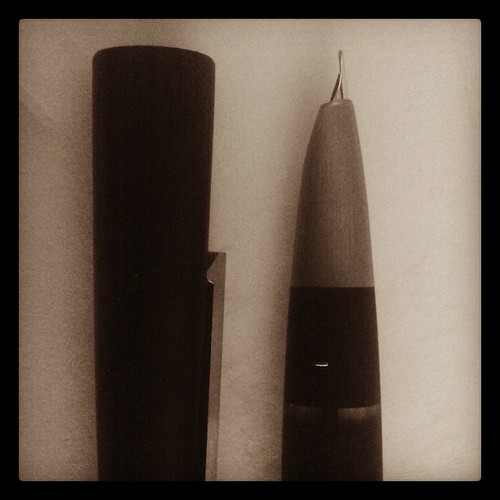
As I mentioned in my previous post, I treated myself recently to a new pen, which I pretended I needed long enough to start researching obsessively, as I do. And in under a week, I'd actually made a decision -- a new record for me! Presto, the Lamy 2000 in artistic hipster square-o-vision.

Classy! #Lamy2000

The last two times I did this, I agonized for months over the decision, finally getting -- and being extremely happy with -- a Pelikan m205 in bright red, and later, a Pilot/Namiki vanishing point in blue and chrome. There's aspects of each of those two that I like and maybe having other examples of "real" pens around made the decision easier. Or maybe I just was impatient. So in the timeless tradition of the chronically indecisive, I made pro/con lists:

Pelikan m205 positives:

+ ink management: massive capacity, visible levels, easy refill via piston system
+ upgradeable: swap nibs by unscrewing
+ fit and finish: Pelikan knows how to make them

…but…

- plastic: model is the low-end of the Pel line (but +light in the pocket)
- smallish: I've got big hands, and unposted, the pen is a shade short
- unsubtle: when subtlety is called for, a bright red pen is not it (but I love it)
- two-handed: I don't post, so the cap has to go somewhere (other hand, usually)

And the vanishing point is almost a perfect complement.

Pilot Vanishing Point positives:

+ brass and metal: a hefty pen, it feels real in your hand
+ a good size, too, for me
+ classy styling, and deploys with a click: an ideal meeting pen
+ excellent build, and love watching the nib deploy and retreat

…but… 

- ink levels are a mystery: even using a converter instead of a cartridge
- so refilling = disassembly, as with most cheap pens, and this is not a cheap pen
- nib updates means buying the whole inner assembly again
- heavy in the pocket, comically so in a breast pocket unless clipped securely

They are both in rotation at work, swapped in as the mood strikes. I have a couple of recurring meetings each week and always take notes, and the Pelikan has never let me down by running low on ink, ever. The VP is ready literally at the press of a button, but I have to make sure to perform the take-apart/refill/wipe ritual before I leave my desk, or pack a second pen for backup.

So, enter the Lamy 2000. What does it offer?

* classic Bauhaus design (says the literature, anyway)
* piston fill for largely clean hands
* magical durable material -- fiberglass and plastic paired with stainless steel, very chic
* a brand/warranty behind it

Here's my impressions after the first few days, in mixed pro/con form:

+ ink handling: it's piston-fill like the Pelikan, so most of the interior is devoted to ink storage, thus I'm still operating on the first fill-up

 - ink levels: warnings about the comically-small ink window are true, so we'll see if I can tell when the well is about to run dry

+ fit and finish: excellent, and the barrel material is prepared in such a way that it looks seamless, even at the end where the piston button seats

+ size and heft: it's comfortable and large enough even in my hand, but not super-heavy either -- right between its two drawer-mates

+ style: the 2000 is so subtle it might as well be a magic marker, and is easily mistaken for one with the cap on. "Pregnant Paper Mate Flair Pen" would be how I'd describe its looks, but in a good way, if that makes any sense

- upgradeable: not so much. A new nib means pen surgery, which is doable, but doesn't appear to be Lamy's intention. Buy a Safari instead if you want to swap nibs easily, or a second pen... :-)

- two-handed: the cap has metal tabs inside to secure it, and it looks like these will quickly scrape up the barrel when posting. So no, the cap goes in the non-writing hand with this pen for certain

 Criticisms that I heard but haven't experienced:

 "Oh, those horrible little metal ears!"

The cap has to snap on to something, and on this otherwise blemish-free pen, there's two spring-tensioned metal tabs or "ears" sticking out on opposite sides of the section. They happen to be at or near where one grips the pen. This evidently aggravates some owners to the point of distraction, a la the Princess-and-the-Pea.

I don't see it.

Oh, they're there all right, and my fingers rest against one of them, but I've not found them distracting, and have been using them even to get the pen aligned properly to writing. Plus, I own and use a vanishing point, which is the ultimate in the having-something-by-your-fingers lifestyle. Not an issue for me.

Bad nib/dry nib/nib takes time to "warm up"

These reports look intermittent, but are vocal -- "I expected better from Lamy, had to send two of them back, etc." Maybe it was a bad batch, or a particular owner with different expectations… who knows. I did flush out the inside of my pen with plain water a few times first (see below) and some of the complaints about dry or skipping nibs noted that it resolved on the second fill. As we know from typewriters, a good gentle cleaning rarely hurts anything.

Stiff piston (hur hur hur) 

Inner twelve-year-old aside, there's observations that the refill mechanism is difficult to work. Is it? It's got to be air- and ink-tight, and I don't think it's worse than my Pelikan's piston. Again, I flushed with water first a few times, to chase away any residual oils and inks leftover from manufacture and quality control testing (some blue ink showed up, so I know the nib wrote at least once.)

Interestingly, using the Lamy has given me another point of comparison, this one for the Pelikan and any pen that refills with a threaded cap:

- inky threads

I don't know how I did it, but there's dried ink inside the cap threads on the Pelikan, probably from brushing up against the lip of a bottle while I was refilling. There's no such issue on the Lamy, as it's smoothness all the way down.

I've heard it's possible to get a fine amount into the grooved texture that's polished into the barrel, but it seems like it cleans up better. It's something I never noticed before now, since I'm usually messing with converters and a partially-disassembled pen or syringes and empty cartridges.

So, is there a clear winner? Not yet for me. I like all three, for different reasons, and for different uses. The Pelikan and Lamy overlap the most in terms of function and usage, and it may be that one goes home to use for marathon writing sessions, and the other stays at work for marathon meetings. It never hurts to be prepared!

Wednesday, April 27, 2016

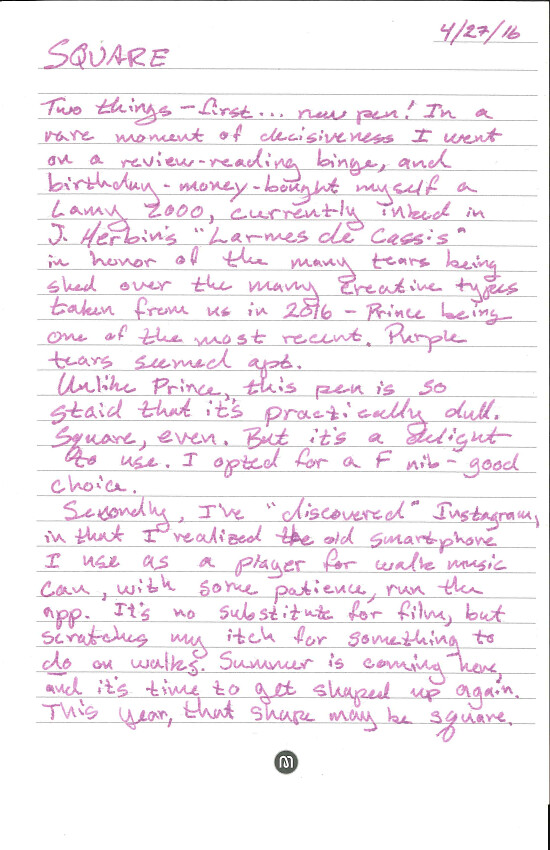
Square

20160427_pencast

Classy! #Lamy2000

Like many social media spots, I'm hanging out as @mpclemens on Instagram if you long to see random abstract blown-out tilt-shift carefully staged snaps of my breakfast cereal, or whatever one is supposed to Instragramify.

Friday, March 27, 2015

Pocket Pen Showdown: Space versus Sport

I've taken to carrying a few index cards and a small pen around all the time, to jot down the million or so to-do items, shopping lists, and "remember to talk to ..." reminders that flit across my brain at this time of year, at the confluence of youth sport and big-projects-at-work seasons. I am still deftly refusing to go the smart phone route, opting for the dumb-slab approach to keeping on track. Here's my dumb-slab:

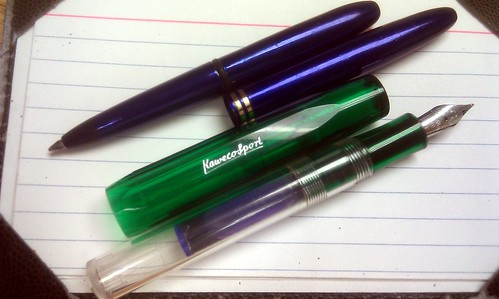
space_and_sport

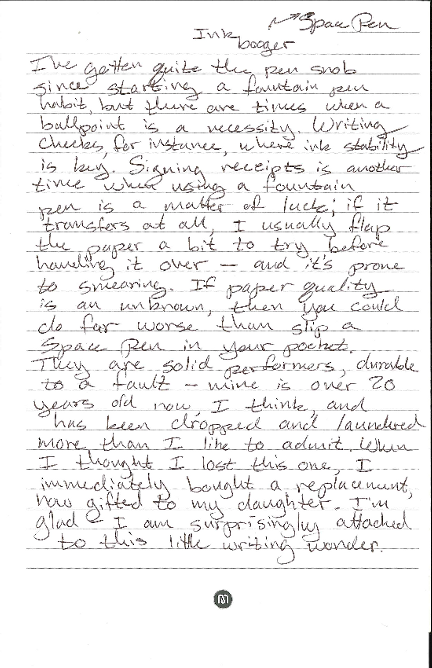
An inexpensive "index card briefcase" that someone gave to me a few years ago, and a pair of pens: the blue one is a bullet-style Fisher Space Pen that I've had long enough that, by eBay convention, now gets to be called "vintage," and a gift-to-myself Kaweco Sport fountain pen. A few thoughts on each, with each. The scanner did a hash of the Space Pen with its boring black ink. It's actually far clearer in real life than this would indicate:

20150327 pencast_space

With the sports team, I've been doing a lot of check-writing and invoice-signing and general scribbling around, and for that, the Space Pen is unequaled. It's tiny, so I can stow it in my shirt pocket, and because of the pressurized ink cartridge and the magic ink, it's always ready. As a regular fountain pen user, I forget about the obligatory get-the-ink-flowing scribble that one must do with cheap stick ball pens (and not-so-cheap ones, too.) The Space Pen is always ready. I don't need to write upside down, or under water, or in space, but I do need to write things quickly, and in limited space, and on-the-go. Try filling out track meet paperwork with a fussy pen while escorting a line of 8-year-olds. NOT A GOOD IDEA.

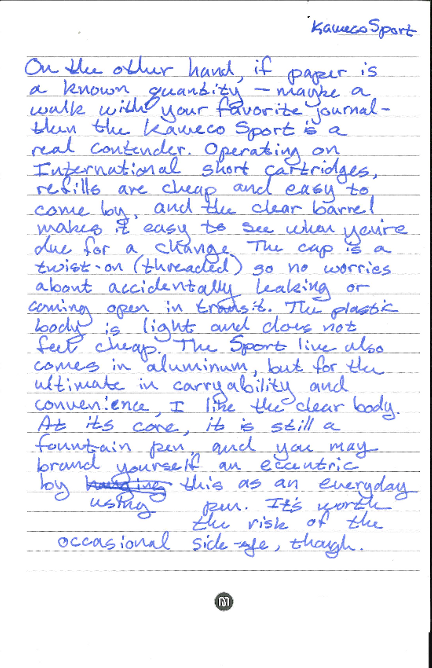
20150327 pencast_sport

The Kaweco was more of an indulgence buy, using a holiday gift card given to me for the always-dangerous enablers at Jet Pens. It was more of a "rounding-out-the-order" buy than filling a specific need, but it's proven itself a fine contender when I have a little more control over my writing environment. I'm still a pen snob, proudly so, and I have no issues fussing with nibs and inks and the whole post-versus-non-post agony. For the record: I'm on #TeamNonPost. Like the Space Pen, the sport is small enough to live in the bottom of a pocket, with no clip to snag. It's not so precious that you feel bad letting it knock around with your keys and wallet, and it's got little touches that make it a fine choice. Swappable nibs, for example, a twist-off cap cap with faceted sides to prevent it from rolling around. I'm a sucker for demonstrator pens, too. ("Look at the ink!")

No pen is perfect, though. The Space Pen -- or correctly, the knock-off refill I am using -- is prone to "ink boogers" around the ball after a period of disuse. I suspect this could be related to the heat of riding in a pants pocket, too. The Space Pen is always easily lost, given its slippery-fish finish. My own example went missing literally in two seconds -- I had it, and then suddenly I didn't. (My wife found it at last, as all excellent wives do for their klutzy husbands.) So upset was I that I finally bought another. Evidently Fisher has started putting a little grip section on the pen, and... I don't like it. Try looking at product shots on Jet Pens. I don't think of myself as sensitive to that sort of thing, but after growing used to the smooth grip of "my" pen, I found it hard to adjust. The new one is my daughter's now, and we'll she what she says.

The Sport I've found to be something of a dry-starter. It writes fine and fast once the ink gets moving, but there's a little refill-squeezing to get the ink down into the feed and the nib. I'm not sure what's going on here, as I'm using the refill that came with the pen. Luckily, ink mysteries are one of the things that fountain pen users secretly love to fuss over, so I'm not too bothered by it, not really. The cap doesn't have any air holes in it, so it's not drying out that I can notice. Kept on its side, it starts right away, but I can't guarantee that sort of storage, bouncing in a pocket or rubber-banded to a journal in a bag.

Finally, nether pen is a very graceful poster -- that is, sticking the cap on the non-writing end. The Space Pen is really so very tiny that you almost need to post the cap, unless you're gripping it in your fingertips, like starting a fire with a match. Which, incidentally, is pretty much how I write with it, keeping the cap in one hand and scribbling with my claw-fingers perched on the barrel. Apologies to all past teachers who tried to show me the One True Light of penmanship: it didn't take. On my Space pen, and on the new variant now in my daughter's care, the posted cap want to work itself off the end a bit, unless you really jam it on. And it's a polished surface trying to grip a polished brass (?) inner ring... so no dice. It tends to work loose no matter what I try. The Space Pen has a small rubber O-ring sealing off the halves of the main pen and helping the cap stay on a bit with friction. Something like that is needed when writing, in my opinion, though I don't know how it would be engineered.

The Sport has the advantage in the posting-the-cap department, I think. The facets bring the overall posted diameter up to something like a "real" pen, and I would imagine that the aluminum models (the "AL Sport") also get a bit of weight balance with the cap hanging out there. I personally think it looks like the skinny barrel is being swallowed whole by some large green worm, and just keep the cap gripped in my non-writing hand as well. Pro tip: keeping the cap is is a good way to get your pen back when it's borrowed briefly. I would not say "no" to a donated AL Sport just to make the comparison complete. Are you listening, Kaweco/Jet Pens? I can be bought, so very, very cheaply.

So, which pen is the winner? Currently, I'm giving the edge to the Space Pen. I was very distraught to lose it, in part because it was a gift, and in part because it's becoming my always-got-it pen, ready for any mundane job. The Sport is seeing less activity right now, but it's got a place in my writing arsenal, and certainly has a greater range of ink choices... and no boogers.

Tuesday, August 5, 2014

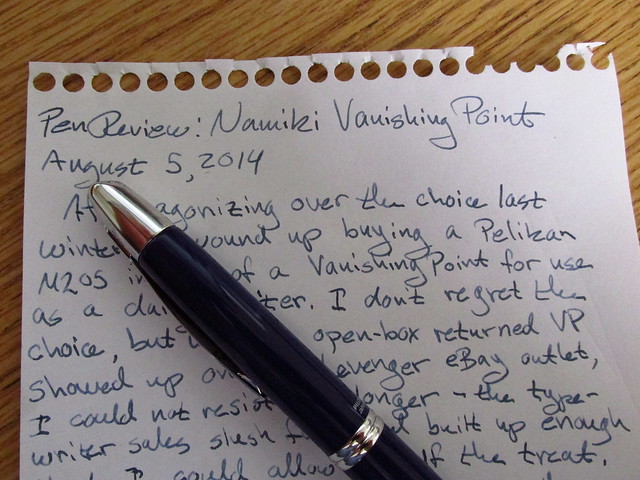
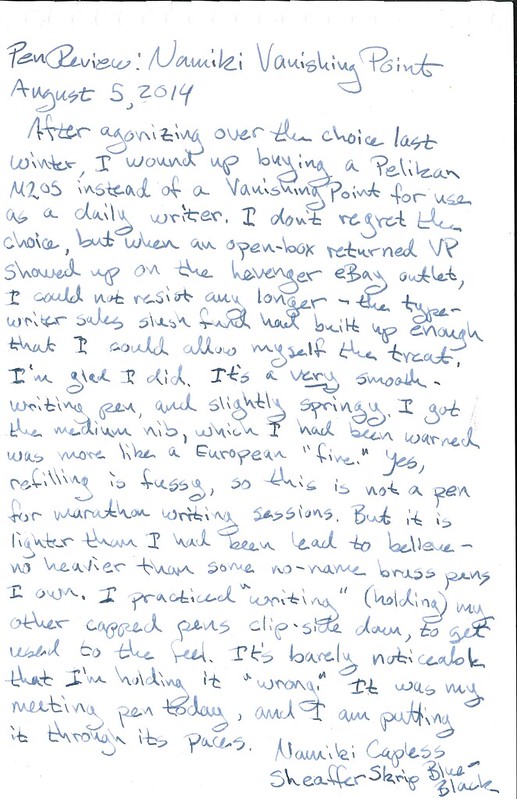
Pen Review: Namiki Vanishing Point

Time again for some pen geekery...

Namiki Vanishing Point

Maybe not a full review, since I've only had it for about 18 hours now, but at least a first-impressions review. tl;dr: I'm very happy with the choice.

20140805 pencast

I have no great love for eBay and I can usually pass up some of Levenger's more esoteric or expensive options, but I am known to haunt their online outlet store. They have famously excellent customer service, so when the listing said "like new, appears to have never been used," they weren't joking. I'm not sure who received/bought this originally and returned it, but thank you. The blue is just sedate enough to look professional, and just happens to be my preferred color. Well done.

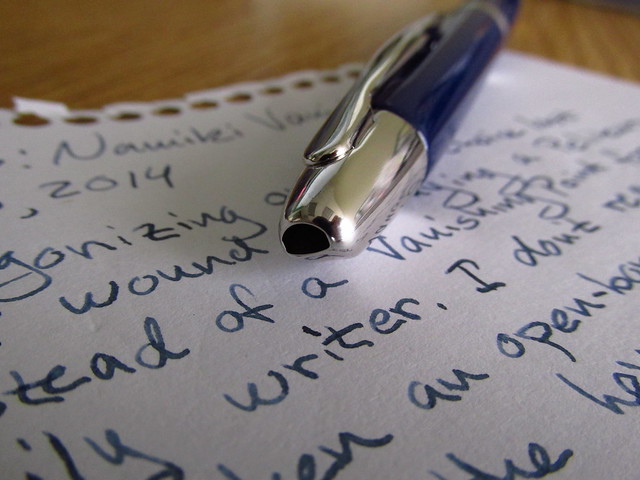
Namiki Vanishing Point - Closed

The mechanism on the vanishing point is pretty clever: this little chromed tailpipe has a tiny flap inside that the nib pushes open when the pen is engaged. The barrel of the pen is serving more like a sheath. The downside is that you're limited in refilling options, since the whole writing mechanism is being moved around in there, so there's no practical way to also add a piston or snorkel.

Levenger helpfully included a cartridge, squeeze converter, and a piston converter. I already have other Pilot/Namiki pens about, too, so care and feeding is covered.

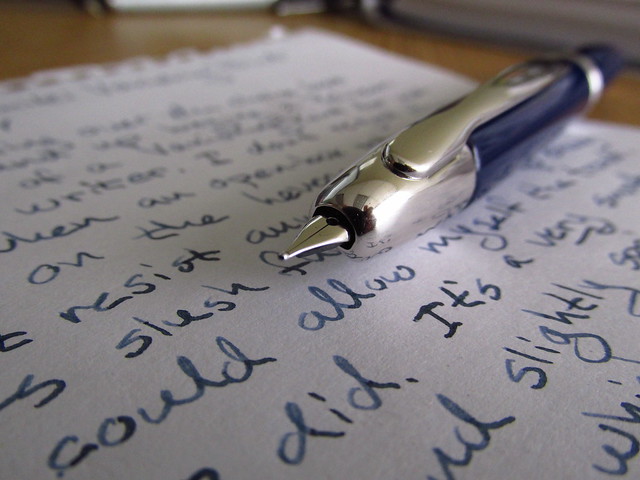
Namiki Vanishing Point - Open

I've heard that new nibs can sometimes squeak a bit when they're first used. I haven't encountered that. I'm not sure if it happens every time or if I lucked out, or if my pre-inking ritual of flushing out the works with water did the trick.

You can see the slightly indented sides on the clip where your fingers are supposed to rest. I don't find this obtrusive at all when I'm writing. It's a subtle tactile guide to holding the pen properly with a triangle grip. Supposedly the tinier nibs can run a bit toward the dry side, so I've read about VP owners choosing a fine enough nib to conserve ink vs. picking a nib that's smooth and not scratchy. I'd personally recommend the Medium, and you can see that it's shading nicely on my scratch pad of sugarcane (bagasse) paper. Just don't wander too far from a bottle of ink or supply of cartridges. There's no window for checking ink levels.

Why go capless? Both because of the sheer coolness of the thing and the convenience. I don't post my pens when I write, that is, I don't stick the cap on the back of the pen. Partially this is out of a desire to keep it looking nice and not scratch up the barrel or crack the cap. Also, it's a good way to ensure that your pen comes back home to you when you let someone borrow it: keep the cap in your other hand. :-) For meetings, or quick notes, or one-handed writing situations (e.g., standing up), a click pen is convenience itself. I will say, though, that the argument that a VP keeps the nib pointed upright ("No leaks!") is just silly. Regular capped fountain pens should be stowed nib-up in your pocket or a case. It's nothing special or unique to a capless pen. Most fountain pen owners who value their wardrobe learn quickly to keep them upright when not in use, and not shove them into a pocket nib-end down. Gravity: it's the law.

Saturday, February 8, 2014

Plastic Pen Showdown: Pelikano Junior vs. Lamy Safari

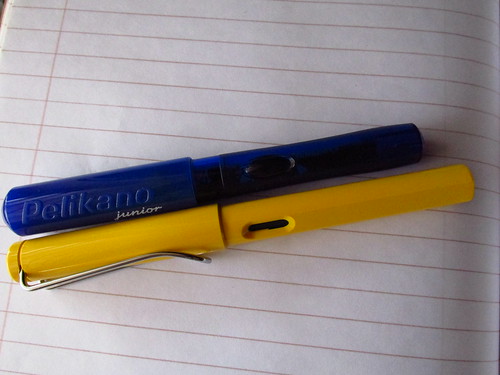
Lamy Safari vs. Pelikano Junior, capped

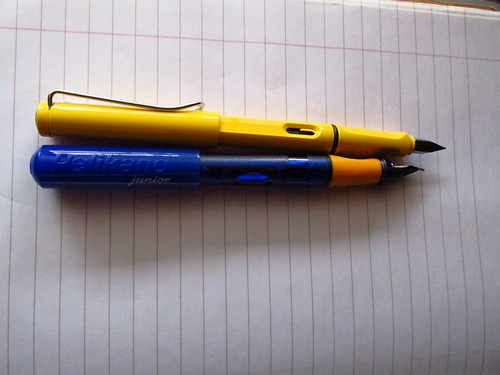
Lamy Safari vs. Pelikano Junior, posted

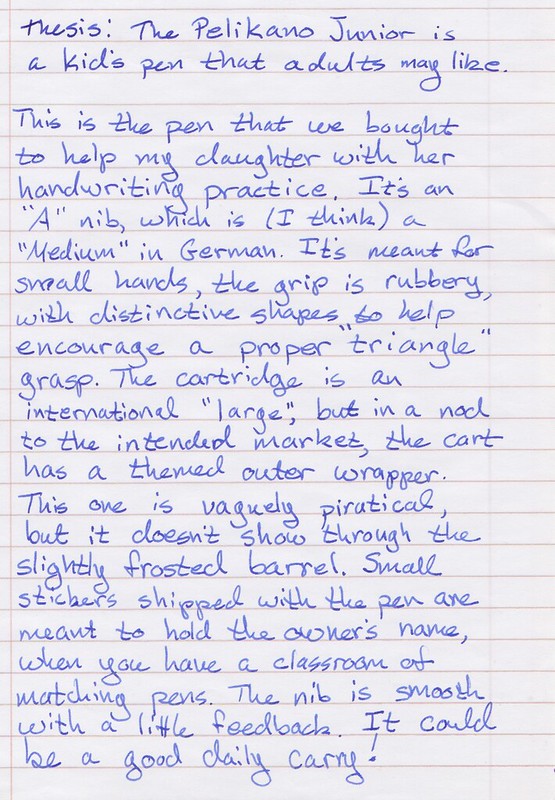
Pelikano Junior pencast

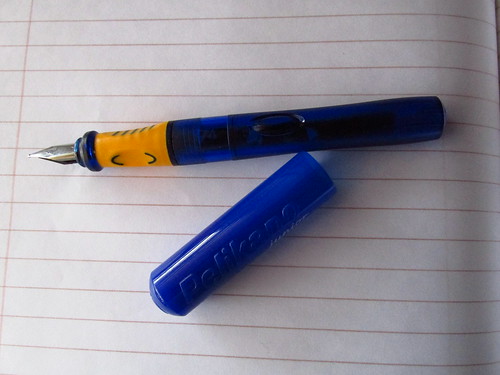
Pelikano Junior

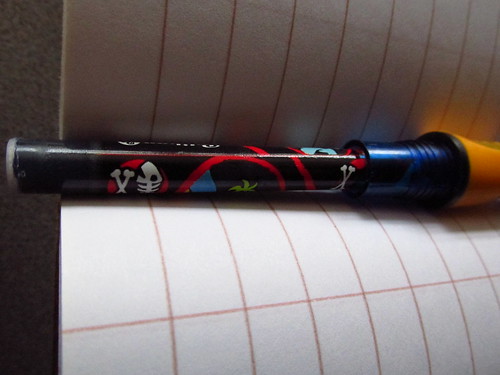
Pelikano Junior ink cartridge

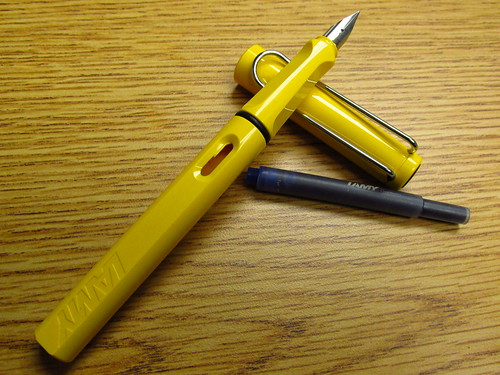
Lamy Safari

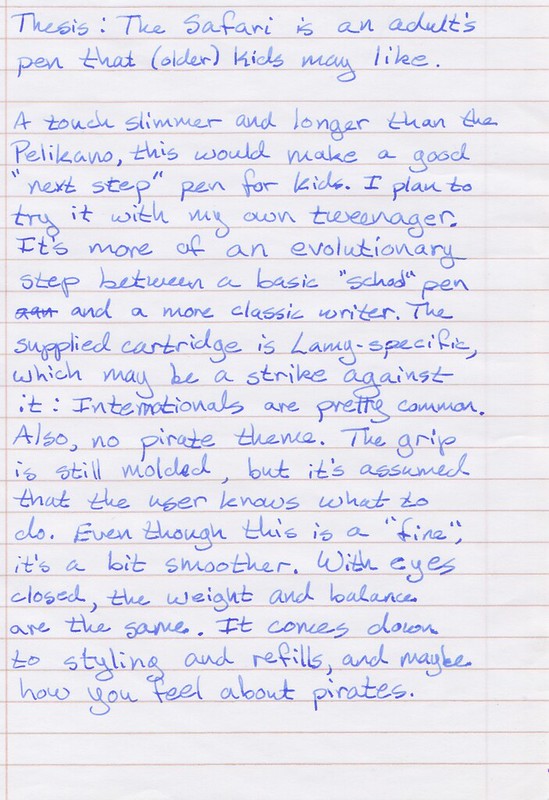
Lamy Safari pencast

Personally, I think pirate-themed ink carts are pretty awesome, and the world would be a better place with more of them around.

There are more similarities than differences between these pens. Both have an ink window, though on the Pelikano Junior, it's a clear bubble molded into opposite sides of the barrel instead of a cutout. That pen also lacks a clip, which probably is by design -- in small, curious fingers, a clip may be bent or snapped off, though it does provide some nice anchoring for keeping your pen from rolling off the desk... or the paper when photographing it.

Both come in a variety of colors, though only the Safari seems to come in "business" colors (black, charcoal, white.) The Pelikano Junior can also be had with a left-hand grip, presumably with those molded pads reversed (the one pictured here is the right-handed model.)

So which one is the best? Like most playground showdowns, this one may come out a draw (no pen pun intended.) The Safari is more grown-up, but also simpler. The Pelikano Junior has a number of well-thought-out details making it suitable for the classroom, but its styling may raise an eyebrow or two in the boardroom. But if you can get standard cartridges -- all the big box office stores around here carry them -- you won't be far from a refill and they last a long time. I suspect they have room for a converter, too.

Safaris have swappable nibs, so as a "gateway" pen, it's got a lot more flexibility and expandability out of the box. It's rare to hear a Safari owner not recommend them to pen newbies.

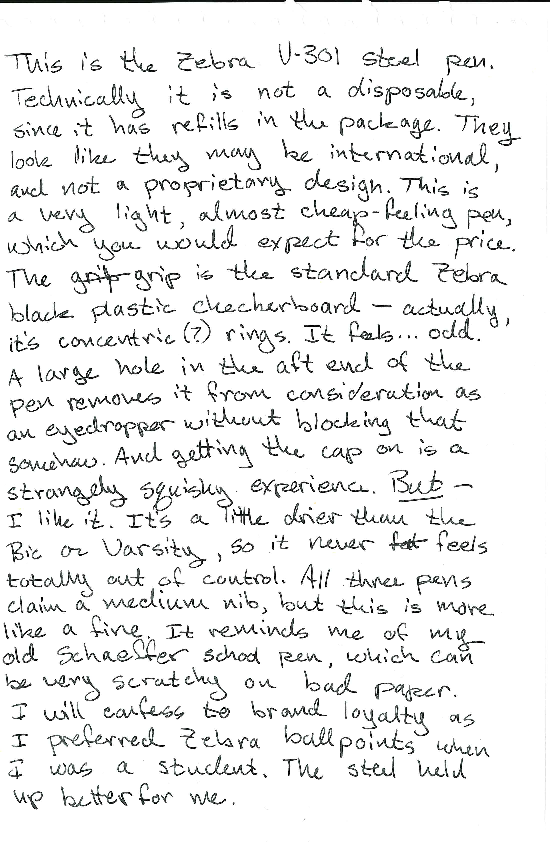
In the end, I think it comes down to budget and personal preference about styling. Unlike the disappointing Zebra V-301, both of these handle great, write smooth, and can survive life in a pocket, backpack, or briefcase.

Which would you choose?

Thursday, August 22, 2013

Disposable Pen Thunderdome

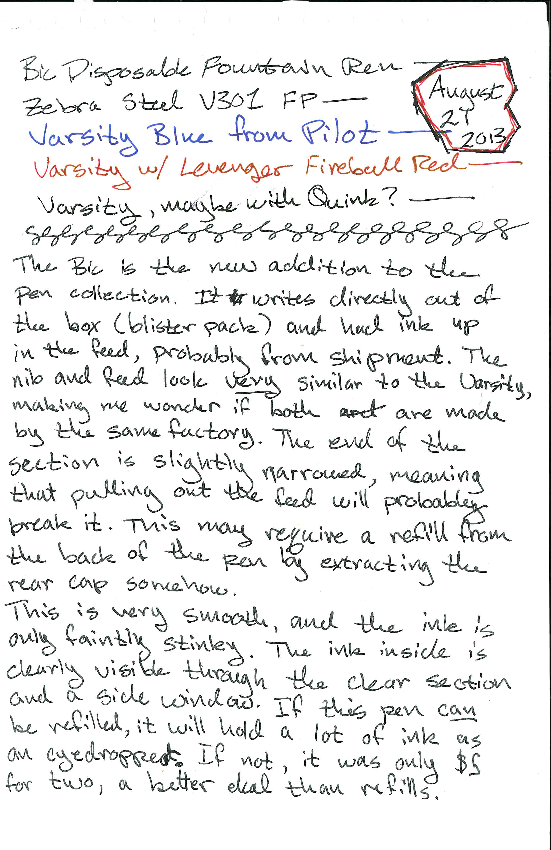
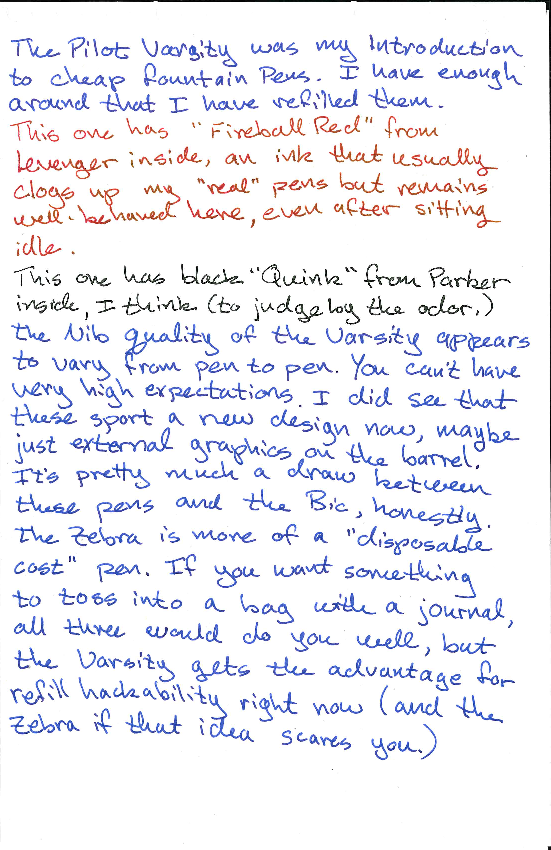
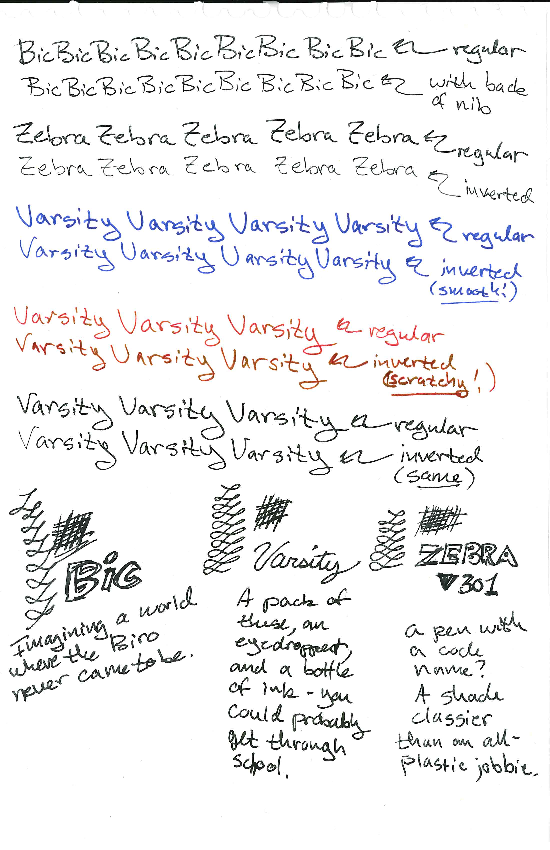
The usual apologies apply for my rambling, twisty handwriting. This was as much about testing the new pad of paper as the pens, but not, tragically, legibility.

My camera has all but given up the ghost now, so you'll have to satisfy yourself with canned product photos from the web sites of the stores where I bought the pens.

* * *

20130821 pencast pt1

I do think it's good marketing to have these pens work right out of the package: no shaking, no refills, just pop the cap off and write. For a steel-nibbed pen, this is surprisingly smooth to use, and at least in my tiny sample size of two pens, both are quite nice. (Confidential to Bic: please send a dozen and I'll give them a proper try.) The ink dries quickly, and there is very slight shading.

I opted not to test some of the other plastic pens I have around, since they are mainly calligraphy pens like the Sheaffers or the Pilot Plumix. In contrast, these three are very much meant to be your everyday-use type writing instruments, with presumably a touch more élan than your standard ballpoint.


Image from Staples.com


It's silly, but I really like the clip on this pen: it makes me think of Jules Verne's Nautilus. As the photo shows, it's all one piece of molded plastic, attached to the end of the cap. The eye-shaped opening in the side is presumably the ink window, and the clear area above the feed also shows the ink sloshing around.

* * *


20130821 pencast pt2

In writing up this page, I realized that there's really more negatives than positives... and I think that pretty much sums up the pen. Doing a little more investigation shows that the refill is not, in fact, a standard type, so when I use up the ink, this pen may just get used for parts. Here's a review with far better photos that sums up the experience. Scratchy, and nothing to write home about (ha!)


Image from Walgreens.com


* * *

20130821 pencast pt3

I'll backtrack on my recommendation comment a bit, given the non-standard nature of the Zebra refills. The Varsity has taken on all challengers, and emerged victorious. That red ink is especially fitful in my regular pens, so it's impressive to me that the pen writes after several weeks -- months? -- of disuse. The caps fit snugly and are airtight. The model shown in the photo below is the original style. I've seen a new barrel design since, and I hope it doesn't change the hackability of these pens.

Image from Staples.com


* * *


20130821 pencast pt4

Conclusions: the Bic is a nice addition to the mix. I'll have to use it up and see how refilling goes, or if it's even possible without destroying the pen. Given the amount of ink visible, that may take a while unless there's some sneaky trick like a tube in the middle giving the illusion of more ink. I hope not.

The Varsity is an easy recommendation: it's usually available in multi-packs of assorted colors, including unusual ones like pink and turquoise, as well as staid business colors, and they really are quite easy to get into, albeit with a little mess if you're impatient for the ink to run out and try to refill early. Or so I've heard. Ahem.

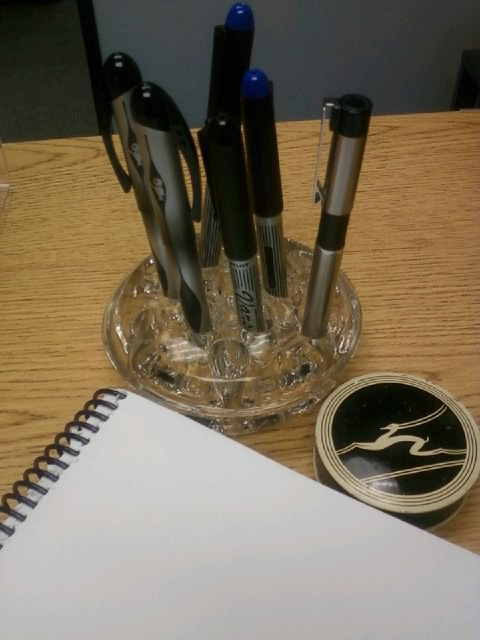
Bonus tip: looking for a way to keep your cheap pens out and available for use? Haunt your local thrift shop/flea market for a glass "flower frog" with wide holes. They're generally inexpensive, and heavy enough to take a full load of pens without hassle. I wouldn't do this with a rare or fragile pen since it could damage the pen or even crack the end of the barrel, but for disposables it's perfect. Here's a crappy cell phone picture of the one on my desk, holding the pens used for this entry, along with one of my new pads of sugarcane/bamboo paper, and a ribbon tin because typewriters.

Flower frog, with pens

Thursday, June 28, 2012

A Quick Pen Review

In yesterday's typecast, I mentioned getting a bonus prize from Exaclair, the U.S. importer of Rhodia products. This all came about because I entered a drawing to win a Rhodia "dotpad" notebook, which uses a fine grid of dots instead of a lined graph. About ten days ago -- long after the contest was over -- the VP of marketing sent out this email:
Dear Friends,

I am sorry for the delay.

We did not like the original batch of orange dot pads so I didn’t send them out to the winners. I have been waiting for the 2nd batch to arrive from France and they finally did. I am now waiting to receive them from our warehouse. I will have them out to the winners, plus a surprise for your wait and time and trouble early next week.

Before I go on, I just want to point out what a class act this is, and I'm not just saying that because I've managed to secure great free stuff from Exaclair. This is exactly how customer service is supposed to work, even if your "customer" is some random shlub on the Internet, as I am. A big hand for Exaclair and Karen A. Doherty, their VP of Marketing. You can send me free awesome stuff anytime...


A couple people asked for my impressions of my bonus prize pen -- as you do -- so here's an impromptu what's-at-hand review for you.

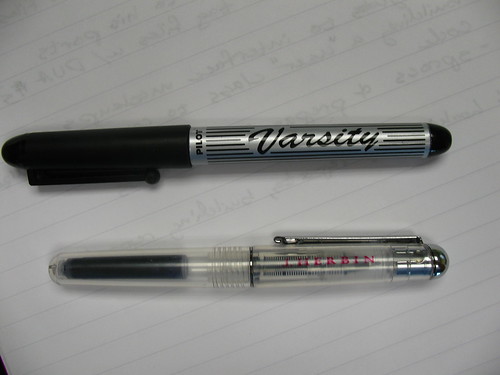
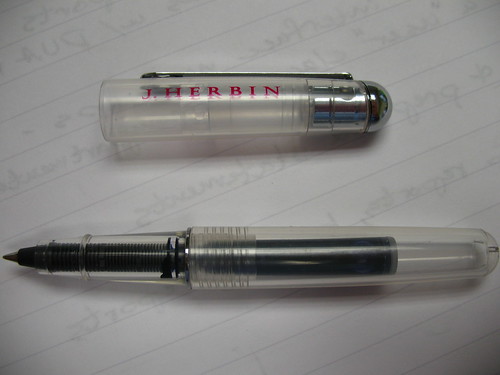
This is not a very expensive product, but it's still a first for me, as I don't own any pens of this style: a ballpoint that accepts a fountain pen ink cartridge. Strictly speaking, this would not be a pen that you'd be heartbroken to lose, if only because it's almost entirely plastic, except for the clip, a decorative metal ring where the cap snaps on, and the point itself. I'd put it in the league of the Pilot Varsity, which is a disposable plastic fountain pen (although it can be refilled.)

Here they are side-by-side:

Pen vs. Pen, capped

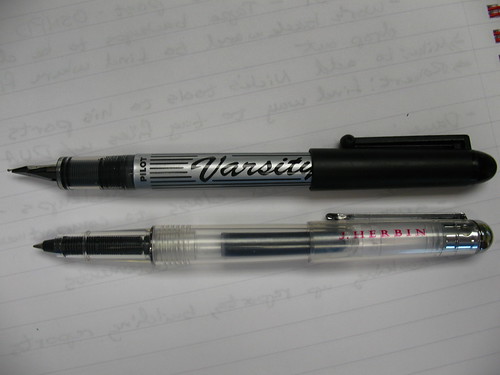
The weight is almost identical, making this pen very light and easy to carry around. It's also about 3/4 of a inch shorter than the Varsity. There's a definite feeling of "smallness" to the ink roller, which, again, makes it very portable and pocketable, but may be awkward to hold in larger hands if you don't post the cap on the back of the pen, like so:

Pen vs. Pen, posted

Even posted, it's noticeably shorter than the Varsity, but not awkwardly. Conclusion: this is a pen meant to be used posted, or by the tiny-handed. Again, since it's all-plastic, it's not like you're doing damage to a valuable writing instrument, but like a Space Pen (which I also own) posting the cap feels necessary.

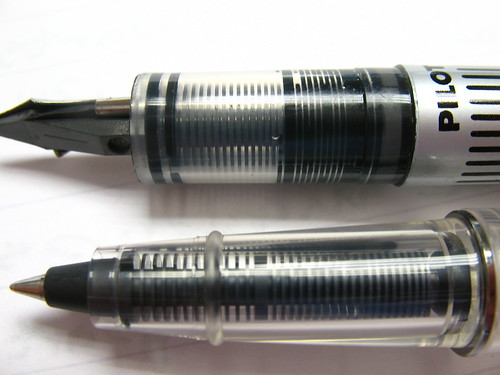
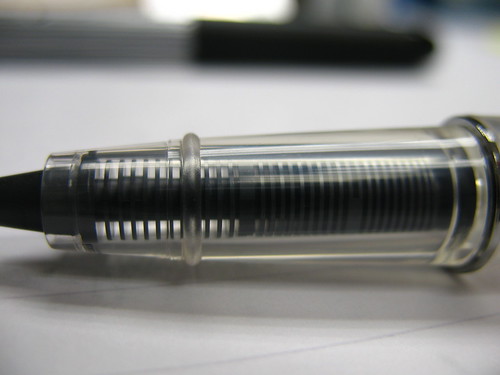
Feed detail

The feed in the roller is visible, just like that of the Varsity. They're very similar, and cleaning between inks may be an issue. To refill the Varisty, you pull the whole feed out, making it available for rinsing.

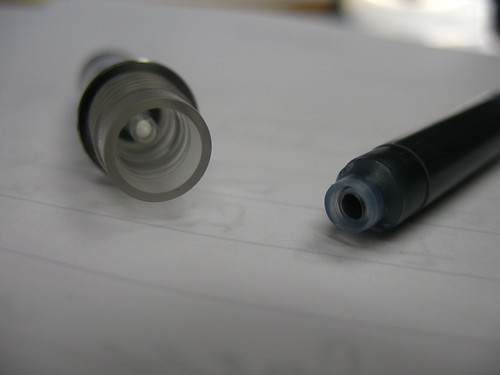
Cartidge and socket

The roller takes standard "short" international-end cartridges, which always makes me happy, since those are pretty easy to come by, often masquerading as calligraphy pen refills. Long cartridges -- like Waterman -- will not fit in this pen, alas. There's a gap once the cartridge is pushed into place, but it's still not enough of a gap to get a long cartridge in there.

Inked and ready

Because I am impatient, I gave the cartridge a little squeeze to get the ink into the feed. I don't know if this is necessary, but it's part of the ritual I have with my fountain pens, and bad habits die hard. Of course this splooged ink into those nice, clean feed fins.

Feed, inked

Oh well. At least we know it's mine now, right?

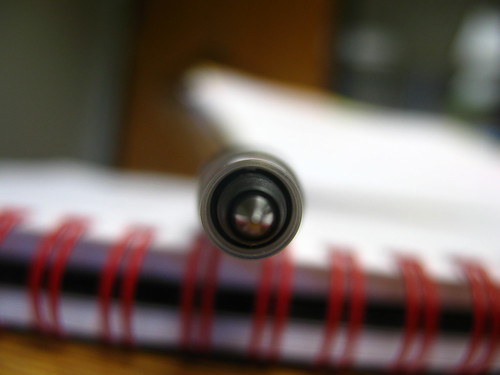
There appears to be a very, very tiny breather hole in the end of the pen, down near the writing point. The ink leaving the cartridge needs to be replaced with air for everything to keep flowing. I don't know if you can see it in this photo, but it's there, right about at the 12 o'clock position.

Breather hole

The dedicated pen hacker (or ink lover) could easily convert this into an eyedropper pen. The cap seals tight with a click, and there are no holes in it that I can detect: the clip is affixed to the outside.

The back of the barrel has a tiny hole in it, which may just be leftover from the molding process. A drop or two of hot glue or clear nail polish would probably seal it up tight.

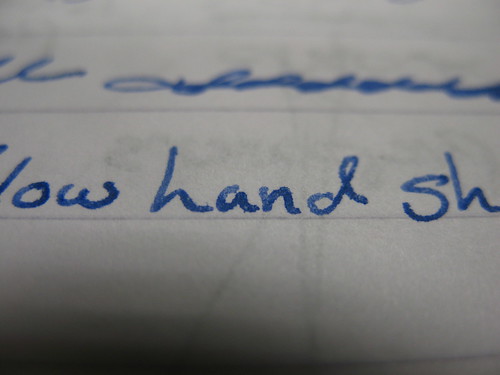
So, how does it write?

But how does it write?

Not bad at all. You're writing with a very fine ball, obviously, so it's not going to be as smooth as a fountain pen, but using the same water-based ink makes it seem slipperier to me. And since it's using a thinner ink, you can also get shading as seen above (and seen better in-person.) Plus, you get the advantage of being able to use all the colors and styles of real inks. There was a blue cartridge inside the pen when it arrived which I used for this test, and Karen thoughtfully added a tiny tin of six dark-green cartridges to use when this one is gone. That's probably the best part of the whole thing: replay value!