Showing posts with label book review. Show all posts

Thursday, October 20, 2011

The Company I Keep

I was having a little discussion with someone on The Twitter today, recommending (again!) Anne Lamott's Bird by Bird as a great resource for writers, would-be writers, and the easily frustrated of either type. The chapter on Shitty First Drafts (PDF) should be required reading, every single November. I know that whenever I pick up my copy of the book, I wind up going back and re-reading the whole thing from the start. Every year I get more out of it.

Anyhow, the Twitter chat made me realize that I don't think I've ever collected all the titles in one place, though I know I've discussed them before. So, here's the contents of my "sage writing advice" shelf.
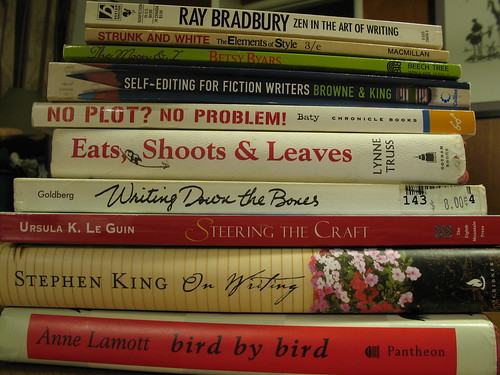

People much smarter than I am

In photo order:
  • Zen in the Art of Writing, Ray Bradbury
    To be honest, not my favorite of the bunch, but it comes praised by many. Perhaps you'll get more out of it than I did?
  • The Elements of Style, Strunk and White
    Because I can never remember how to do quotes. Also, because I am trying to become one with the philosophy of cutting surplus words, if not in this blog, then at least in my writing.
  • The Moon & I, Betsy Byars
    Hilarious, unless you are snake-averse. Then probably seriously creepy. Writing advice disguised as autobiographical stories.
  • Self Editing for Fiction Writers, Browne & King
    The book so nice I braved the vultures circling Borders books to get my own copy. Makes a good argument for putting the extra effort into revisions of your own work, and gives real-life examples. My post-NaNo Sherpa. I reviewed this one earlier, though you may also want to check out Bell's The Artful Edit and Lyon's Manuscript Makeover. I preferred the Browne & King book.
  • No Plot? No Problem!, Chris Baty
    The pre-NaNo Sherpa. I picked this up after my first year of NaNo. Certainly not the most serious book, but then NaNo isn't the most serious creative endeavor, either. Baty's novel aftercare advice about summarizing scenes on index cards inspired my current pre-noveling process.
  • Eats, Shoots & Leaves, Lynne Truss
    If your blood pressure ticks up a notch every time you see an abused apostrophe, read this. Funny for Type "A" personalities like yours truly. Obnoxious to everyone else, probably. Read immediately after (or in parallel with) Strunk & White.
  • Writing Down the Bones, Natalie Goldberg
    Slightly hippy-trippy compared to the others in the stack, but her mantra -- keep your hand moving, always moving across the page -- is invaluable advice.
  • Steering the Craft, Ursula K. Le Guin
    Meant more as a workbook than a read-from-cover-to-cover work. Le Guin does get into discussions of taking criticism in a peer writing group, which is the only book I've found that does this. Type "A" people need all the advice we can get about accepting criticism gracefully and silently.
  • On Writing, Stephen King
    Also largely autobiographical, and King has led a colorful (and medicated) life. Solid advice, though, from someone who knows how to make popular, readable work. Also: a sample of before-and-after edited work.
  • Bird by Bird, Anne Lamott
    Still among the very best in the pile, in my opinion, especially for writing-and-life advice. So many books that I've read were very dry, highbrow, academic books written by Serious Authors Crafting Serious Art. This is not those books, thank goodness. This is the one that gets me back in the NaNo frame of mind every year. After reading it, I'm excited about writing something terrible and bloated and meandering and occasionally surprising and subtle and wonderful.
Now obviously, one or more of these books simply won't do it for you. (Hopefully you are not also a planning-obsessed control freak, 'cause this here blog ain't big enough for the both of us...) If you're looking for some advice from smart people, though, you could do worse than this stack of paper.

Friday, August 19, 2011

Drive-Thru Book Review: This One's for the Ladies

The Wonderful Writing Machine
by Bruce Bliven, Jr.
no ISBN, search on AbeBooks.com

I mentioned in a previous post that I met up with the guys filming the typewriter documentary, and that my interview was held in a local bookstore. Well, you have them to thank for this review, since the owner of the bookstore pulled this title off the shelf for me when I went out to talk with him face-to-face about the possibility of using his shop. My copy of this book is pretty beat up: it's a discard from a local library, though it amazingly still has its dust jacket on it. The book was written in 1954, and in the forward, the author thanks Royal Typewriter Company "[f]or complete freedom to explore its offices, factories and files, along with permissions to interrupt its busy personnel with my often foolish questions [...]" That little forward, plus the fact that this was written in 1954, led me to two immediate conclusions:
  • The book will be filled with shameless Royal cheerleading
  • The book will be filled with the pervasive sexism of the time
In other words, a great read. Of course I bought it and brought it home. Color me surprised, then, when I read all the way through it, and found almost none of what I'd expected. Almost. But more on that in a bit.

What I found, much to my surprise and delight, was a well-written, entertaining, and sometimes funny historical journey through the life of the typewriter, from the first crude inventions, to Sholes and the Remington partnership, through the adoption of the typewriter as a necessary tool of business. There's some hints that the manual, mechanical machine's days are numbered -- a brief allusion to advantages of the electric machine, and discussion of the labor-intensive nature of typewriter manufacture and adjustment -- but this book is clearly a product of the peak of the typewriter age. Classic photos and illustrations are sprinkled throughout the book, with (I assume) Bliven's captions: several photos of pre-Sholes machines, various period photos of "stylish typists" of the early twentieth century, and at the end -- and only the end -- photos from the Royal factory, which surely seemed high-tech and impressive in their day (hand-grinding the segment, for instance. Ye gods.)

Only in the last quarter of the book does Bliven really show allegiance to Royal, and even then it's a smirking one. The hijinks of one of Royal's more infamous marketing guys and his stunt to drop typewriters on parachutes from a plane, for example: that's good reading, no matter what your brand preference. Chapter 11 ("Adjuster at Work") goes on a bit, but as a contemporary caretaker of a machine or two *cough* it's a window into the level of attention that surely went into the big Royal I have at home. Somebody spent a few hours with it, just making sure the N lined up with the A and the O. Somebody in a big factory wing, seated side-by-side with a few dozen other somebodies.

The only cringe-worthy portion of the book is Bliven referring to "the girls" or "your girl" when referring to the typist, but again, this happens later in the book: late enough that it makes me wonder if it was grafted on. (The forward indicates that portions of the book were previously published in Atlantic Monthly and Collier's magazines.) Through the earlier chapters, Bliven is a good deal more equitable, and sometimes sounds downright progressive, even. But taken as a whole, it's fun book, and worth checking out if you can find a copy.

Wednesday, August 4, 2010

Drive-Thru Book Review: Back to School the Hard Way

Manuscript Makeover: Revision Techniques No Fiction Writer Can Afford To Ignore
by Elizabeth Lyon
ISBN: 0-399-53395-8

Summer is nearly over here -- the big red First Day of School appeared when we flipped the calendar -- and that means my summer revision-reading frenzy is about complete. Only three short months until NaNoWriMo 2010 kicks in, so two months until I start my pre-planning rituals. With all that in mind, I was looking for a big sendoff to see me through that last two-fifths of last year's draft: some wisdom that would let me put it to bed for a while and clear my head of the old to make way for the new. I've limited these reviews to the (mostly) worthwhile titles: there have been a couple of stinkers in the bunch, including one that name-checked President Carter and took a few friendly (?) jabs at the women's movement. I've been shooting for a mostly-wheat/low-chaff ratio here, and hope they've been informative to you. I've certainly learned a lot from reading all these books, especially in how little I actually know when I slip on that "Editor" hat.

Few books have thrown that knowledge gap into such sharp relief as this one. Despite its small size, this is a hefty book, at 336 pages of text and chapter reviews. It would be very suitable as a textbook, if only because I feel like I got schooled by reading it (as the hep kids say.) Lyon pulls no punches in laying out the components of a successful work, and as I read through the chapters and examples, I'm very aware of how far my own draft has to go. It's not a dense book, and certainly not a hard read, but more than the others I've gone through this summer, it's one that has made me slow down and pay attention. (I skimmed that Carter-era book in around three days.) In fact, I've been reading it so slowly that I had to renew it, just because I want to sit down and take some notes. Heavy schooling indeed.

She's divided the book into four parts: style, structure and pacing, characterization, and marketing. I only gave the last part a pass and a light read, but it's also the smallest portion of the book (Lyon has another book dedicated to this specific topic.) And to tell you the truth, I was pretty dispirited by the time I got there. Sell the book? With the shape it's in, I'll be lucky if I can get anyone to read the book. Clearly, some major reconstruction work is ahead. But it's not all gloom and despair. I learned that my novel could be classified as picaresque, which is a wonderful four-dollar word to whip out the next time I'm invited to a snooty wine-and-cheese mixer. Ah yes, my previous novel was a picaresque comedic fantasy, you know. Sounds nice, even with a mouthful of cheese.

I recommend Manuscript Makeover if you're strong of stomach and willing to hold your own work up to a very clear, high-definition mirror. And if not, might I recommend a little wine first?

Friday, July 16, 2010

Drive-Thru Book Review: No Hooptedoodle Allowed

Elmore Leonard's 10 Rules of Writing
by Elmore Leonard
ISBN: 978-0-06-145146-1

Originally published in the New York Times nine years ago today, I have come across used copies of this book for sale, and finally checked out a copy at the library yesterday as part of my Summer of Book-Learnin'. Despite the heft, this is clearly a gift book, meant to be left out and admired and flicked through, with humorous illustrations of the author or the authors he talks about. I wouldn't pay the $15 this book originally cost, especially when you can just read the essay online for free. Bounce on back to that first link in this paragraph to see it, sans illustrations. Go on. I'll wait.

Back already? Yes, it's a quick read. I zipped through the whole thing over breakfast, and that's before I was fully awake. But that doesn't make the contained advice any less worthwhile. Leonard's rules are simple and b.s.-free, much like his writing, and are a refined distillation of the same advice I've read and re-read over much of this summer. I wish I'd found this last fall, in fact: the advice would surely have spared my draft the many adverbial indignities I heaped upon it, and soothed the nagging doubt I had that you need only say "said" in dialog, and nothing more. I may keep a copy of the essay by the typewriter this November, just in case.

I say: read the essay online and spend the $15 on typewriter ribbons.

Wednesday, June 30, 2010

Drive-Thru Book Review: The Fitzgerald Admiration Society

The Artful Edit: On the Practice of Editing Yourself
by Susan Bell
ISBN: 978-0-393-05752-2

The previous book I reviewed was on the how of editing your own work. This title is more about the why of editing. Both the self-editing book and this one talk about The Great Gatsby as the classic example of a well-edited novel*: a fact that Bell does not fail to mention. Repeatedly. Only on going through the acknowledgments and bibliography did I discover that the author published an essay and taught a course on the subject. This would have been good to know going in, as my only memory of Gatsby is likely the one many share: being forced to read it under great duress in a high school literature class. Bell does pepper the work with some examples of before-and-after, but primarily to marvel at Fitzgerald's ability to tone and refine. Admirable, but not quite as useful to those of us who are painfully aware how far short of Fitzgerald we fall.

Chapters are:
I. Gaining Perspective
II. The Big-Picture: Macro-Editing
III. The Details: Micro-Editing
IV. Master Class
V. Servants, Dictators, Allies: A Brief History of Editors

Plus copyediting symbols, bibliography, acknowledgments, and credits. There are some practical points, though the advice is not unique to this book. What I found most interesting were interviews that Bell conducted with authors, or editors (not all copy editors), many of whom offered insights into their methods. As a whole, though, the book is more a philosophical treatise on the "art of editing" than a guideline to "the practice of editing yourself." (Oh, judging-a book-by-its-cover, how you have failed me yet again...)

I didn't dislike the book (honest, Monda!) but I'm already convinced of the need to edit and the value of re-reading and revising with an editor's eye instead of an author's. If you need to psyche yourself up to making an editing pass at your own work, this would be a worthwhile read. But if you're in the editing trenches, trying to triage your sentences, you won't find any bandages here.


* I suspect that one reason Gatsby is held up to such praise is that early revisions of manuscripts and correspondence have been preserved, and that like me, many people have been exposed to it as a Classic at some point in their lives. There may be other works that have the same documentation available, but Gatsby is slim and approachable.

Wednesday, June 23, 2010

Drive-Thru Book Review: Self-Editing for the Fiction Writer

Self-Editing for Fiction Writers: How To Edit Yourself Into Print
by Renni Browne and Dave King
ISBN: 0-06-270061-8

I'm nearing the end of the digitization/first rewrite stage of my 2009 NaNovel. I'm pleased with myself, as this is the first of my three NaNo entries I've read completely and bothered to type into digital form. (I bottomed out in the first third of 2008's novel, and 2007's shall not be Spoken Of Here.) Revisiting a draft done in such a hurry is wince-inducing: beyond the obvious like fluctuating character names and all the "do in rewrite" footnotes, I find myself struggling with mixing dialog and action, wanting to spell out every character's motions in every scene, and trying to understand just what exactly is meant in writing books by "show, not tell." Self-Editing has come to my rescue.

I happened on this book two weeks ago when I was at the bookstore, flicked through the pages, and though it looked like a worthwhile read. My library had a copy, and I just finished reading through it last night. Chapters are (with my comments):

1) Show and Tell [examples of exactly that]
2) Characterization and Exposition [avoid the latter via the former]
3) Point of View [first person, third person, omniscient]
4) Dialogue Mechanics [just what it sounds like]
5) See How It Sounds [read your prose aloud]
6) Interior Monologue [how to do it]
7) Easy Beats [handling excessive "stage business" in your scenes]
8) Breaking Up Is Easy To Do [using whitespace for pacing]
9) Once Is Usually Enough [don't repeat]
10) Proportion [focus on what's important]
11) Sophistication [don't write like a novice]
12) Voice [your characters need distinction]

Each chapter presents before-and-after samples of prose, typically pulled from contemporary works (this edition dates from 1993), though peppered with illustrative text from classics. I thrive on examples, and this book did not disappoint, except for the nagging feeling that my own draft neatly illustrates almost all the "before" problems. Sigh. Exercises are presented at the end of each chapter, with an answer key in the back -- more examples, really, as they illustrate how the authors (both editors) would have refined the passages. I skimmed over these after reading the chapters in my eagerness to get to the next one.

The tone in the book is light and instructive, not scolding, and at least the first edition comes with the occasional cartoon from George Booth -- if you've flicked through a New Yorker magazine in the past decade, you've seen his work. They're not necessary, but fun (and often featuring typewriters, so hey, on-topic for the blog.) This is a very approachable work for novice and amateur writers, and I can see how applying the lessons from the chapters can make my own work tighter and more readable. Once I finish retyping it, that is.