Showing posts with label memory. Show all posts

Saturday, May 14, 2016

Guilty Pleasure: The Casual Extermination of Mankind

I was, of course, an odd child, the kind that would be more likely to bring a book to a swimming pool in the summer than actual swimwear. (True story from when I happily sat under a tree devouring Robinson Crusoe while my siblings splashed and sunburned.) So maybe I was marked from the start to love H.G. Wells' classic The War of the Worlds. I've owned a couple of copies over the years, and read them until the literally fell to pieces -- one of them had particularly haunting line-illustrations of the infamous Martian war-tripods lighting a terrorized crowd aflame.

Good times.

I still have one copy, a cherished anthology given to me around age 11 or 12, a hardback edition bound in green leatherette with gilt-edged pages, collecting some of Wells' more famous stories, all of which were poor seconds to my favorite of the bunch. I read and re-read that story, which held the honor of coming very last in the volume. I'd make myself try to get through the other tales first, like suffering through over cooked broccoli to make the eventual dessert all the more sweet.

I don't know what it is about the story that triggered such admiration. (And here be spoilers, if it's possible to spoil a century-old tale.) Wells wasn't afraid to be lurid in his descriptions or brutal in his apocalyptic vision for the fate of mankind, and he certainly showed a wry understanding of the power of a twist ending long before The Twilight Zone made it fashionable. Wells was the master of the Gotcha ending before it became cool. I'm sure, as a boy, I enjoyed the visions of the wild marauding tripods ravaging over field and village, unleashing destruction at ever turn. Humans are merely fodder and food, obstacles to be eliminated, and its not through any heroism or brave deeds that mankind ultimately survives. It's not a story of bravery, or cleverness, or heroism coming to save the day. It's more a study of man at his worst, and how much luck is part of his survival. At least I hope it is.

Because honestly, I haven't picked up the story in ages. I still have that green-bound volume in place of honor on our "classics" bookshelf, wedged in among Alice and Frodo. The gilt edges are lost from the pages, and the bottoms are slightly waterlogged from being propped up on my stomach: poolside, of course. I'm a little afraid that it won't hold up. Another beloved childhood book did not, upon a recent re-read. Jules Verne's Mysterious Island also hit a sweet spot in my consciousness at the same time, and I read and re-read it many times. I remember being genuinely excited when both it and The Hobbit were handed to us as texts for a class. Both were favorites, but unlike Tolkien, Verne did not stand the test of time. I've since found Island to be rather fawning, aggravating, and generally dull. It's the opposite of War, as Clever Men solve Interesting Problems in a Clever Fashion. Rereading it as an adult was not time well-spent.

So, I'm hesitant. I'm nearing the end of my every-now-and-then re-read of The Lord of the Rings (yes, even the Appendices, because envy.) And there on the shelf, in the gap sits Mr. Wells. And for my birthday, I did treat myself to the Jeff Wayne musical version of War, which has all the earnestness, schmaltz, and disco guitars one should expect from a late 1970's concept album. I've been listening to it a lot, lately. Quite a lot. Enough that my co-workersare surely dreading the opening string-section chords, right before the wocka-chicka disco bassline kicks in. (And the chords are good. Made them my ringtone. I'm still an odd child at heart.) The bones of the story are present in the musical, and as an adult, I can see a lot of themes that either Wells or Wayne are throwing in there: colonialism, fear of the machine age, the mechanization and dehumanization of war. Descriptions of Londoners fleeing the invasion especially feels poignant as we see Syrian refugees fleeing their own horrors (and it is all side that are dropping the "cylinders.") It may have been a gripping and exciting poolside read as a child. Under the guitar solos and the Big Pop Song Number of the Wayne musical, it's still a dark and frightening story.

So there's my confession for tonight. Strange, pasty child with an overlarge book on his lap, both cheering and fearing the Martians, and wondering as a strange, pasty adult if they will still hold the same thrill. I listened to the musical yet again this morning as I worked my required co-op hours. At the pool.

Friday, June 6, 2014

High, Concept

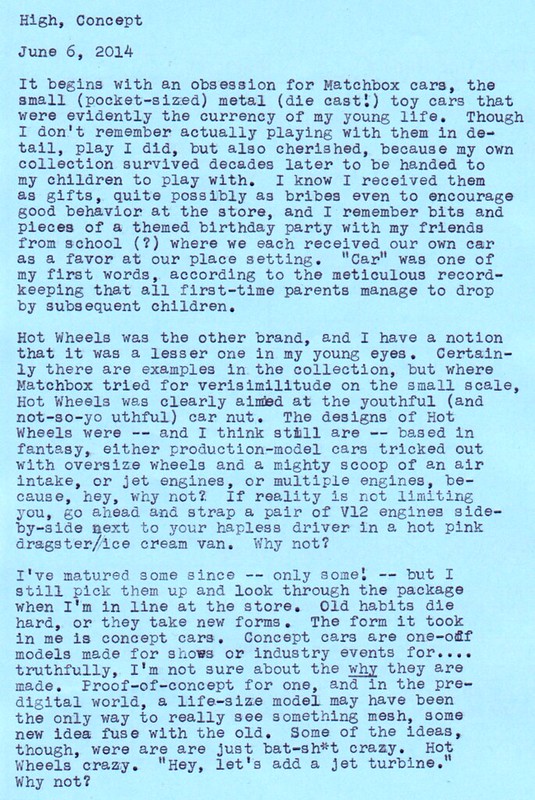
typecast 20140606 pt1

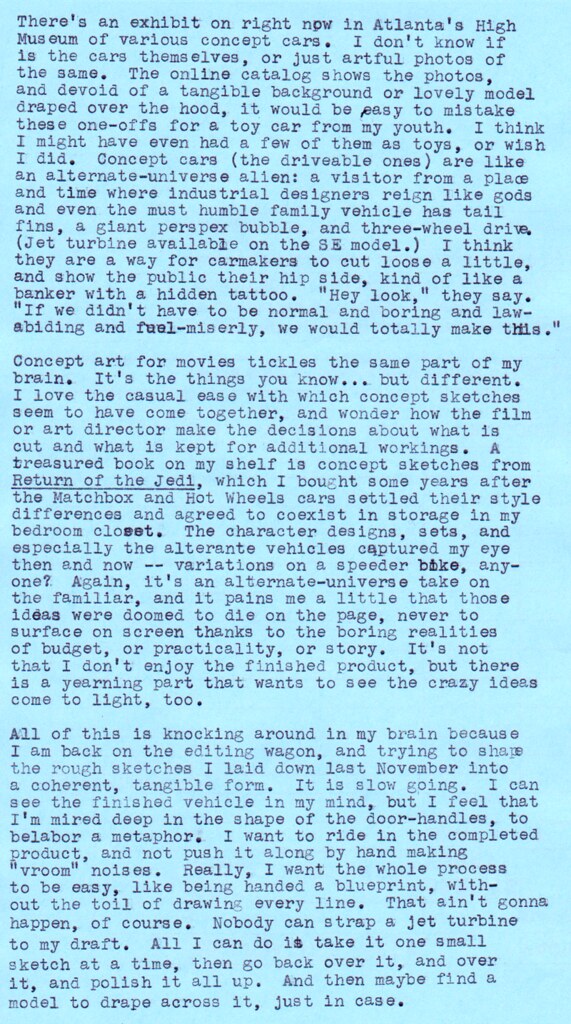
typecast 20140606 pt2

For as long as it lasts, here's the exhibit in question, but a quick interwebs search can find you information about numerous concept cars, including ones that should have been in my toy car collection, if oil embargoes hadn't spoiled everyone's fun.

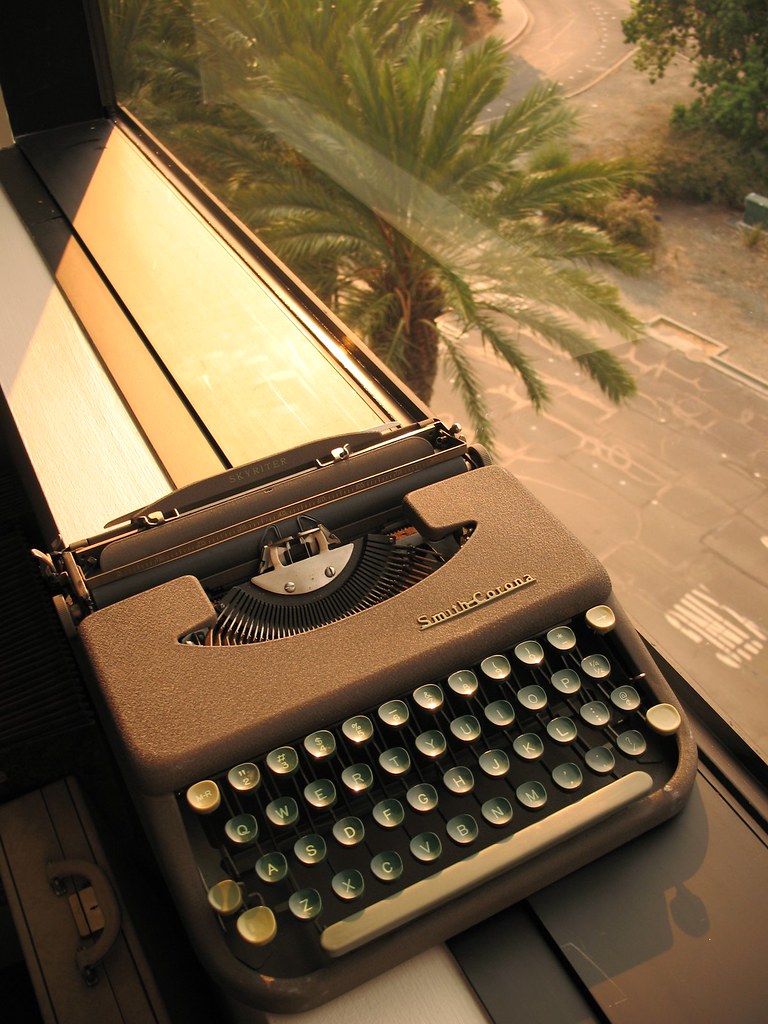
Typed on a 1952 Smith-Corona Skyriter
Smith-Corona Skyriter c. 1952

Tuesday, May 13, 2014

Walk, man

20140513 pencast

And just like that, a month goes by between updates. Somehow it never feels like it's that long away... and then it is.

So, I'm back, in some capacity anyway, and hoping to put the newly-freed time to better use than what I've been doing lately, which is loafing and playing way too much pinball. The weekly library walk is a good sanity-maintainer, as it's something to look forward to in the work week and good exercise for the largely sedentary lifestyle of someone who makes his living behind a keyboard. Our library system has a number of branches and a particularly excellent online system for reserving books and having them ready for pickup at any branch. I don't know if this is the norm now, but it's incredibly convenient.

That cassette collection (of questionable taste) lived in one of those huge zippered nylon cases under the bed in my dorm room, and was fed at first thanks to the largess of the back catalog of the BMG Music Club (12 albums for a penny!), by careful duplication of friend's cassettes, and then in years later, by legging it to the library to riffle through their CDs. Some of those old albums are permanently embedded in my brain with the place, so (for example) the tape I made that backed Naked Lunch with Different Trains automatically takes me back to a late-night drive across central Indiana to pick up a friend from the airport. Some of the more regrettable 80's pop songs are instant time-travel back to college years, walking around the pond near campus just as autumn was turning and all the sugar maples dropping continual showers of orange and yellow leaves. (This ink color is close, but nowhere as vivid.)

Scent is a powerful memory-trigger, but I think music is an actual time machine for your brain.

Monday, January 9, 2012

The Quest for Cover Art: Wisdom of the Bowker

Rob Bowker passed along a very helpful email to me, and rather than butcher it by trying to recap, I'm going to include a slightly edited version here:

BEHOLD

Here are some suggestions about what to include in a brief to an illustrator:
  • Size, especially height to width ratio
  • Layout: do you want an illustration to bleed off the edges (no margin), or just a spot illustration?
  • Colour: a black line drawing with a spot colour will be less expensive than a full colour 
  • Text area: to produce an all-over cover, the illustrator will need to know the precise positioning of the all the type - unless they are including the type as well.
  • If you are selling digital editions, the image will need to work as a smallish thumbnail.
  • Budget. An illustrator may ask for 50% down, 50% on completion. A full blown painted illustration may take a day or two, so could run to $1000 plus. You need to decide how much you can afford to spend. Remember, every time you change your mind, the meter keeps running. See above.
  • Show and tell: grab an example of something that tickles your fancy and say "like this".
Remember, there are a thousand different ways to illustrate your book - but you can only choose one. It will be a compromise. Also, it can be a bit of a roller-coaster ride and you may not end up where you thought you wanted to go - but it could still end in a perfectly good place if you treat it as a collaboration more than a simply transactional commission.

Concise and helpful, yes? I hope Rob doesn't mind me co-opting his email for what is basically a free post. I'll be sure to compensate him in whatever imaginary currency bloggers use. (I'll send you some of the Russian spammers that drop links in my comments, Rob.)

For a short while in my professional wanderings, I did happen to work for a spinoff of a printing company, so although I may not know the exact terminology, I do understand "gutter" and "bleed" and at least some of the issues of print... circa 1995 or so. Of course, the world has also changed dramatically since 1995. To wit: the company that I was working for was going to ride the Next Big Technical wave -- interactive CD-ROMs. It just so happened that I'd done some HTML, and then suddenly we found ourselves making web sites instead, with the culmination of me shaking hands with and receiving a signed mouse pad from Fabio. (Oh, the dot-com years were strange ones indeed, my friends.)

For those inclined to go the DIY route, there are certainly tools out there to simplify the process. NaNoWriMo folks get a discount on getting a proof copy printed up by CreateSpace (aka Amazon), which I've done with a much earlier draft of the book in question:


Time to Edit, or, the Proof is in the Pruning

It was done in a hurry, with a stock layout and photo on the site, but like Mr. Speegle, I have to admit to the electric thrill of holding something bound with my name on the cover. But now there's the considerations of making only what amounts to a single image, possible rendered in gray-scale on an e-ink screen as well as a full-color tablet. When the bookshelf is virtual and the "book" is palm-sized, how does the illustrator's craft adapt? I've even toyed with the idea of per-chapter illustrations a la a certain other fantasy title (cough Harry Potter cough) but then realized that honestly, the whole layout of the book is really up in the air, as you can't depend on the device. You certainly don't want any additional art to distract from the reading experience.

Frankly, the whole thing takes me back to that job in the mid-90's, trying to reduce .GIF sizes and design to accommodate 640x480 screen resolutions and to make pages AOL-friendly. I should straighten up in case Fabio comes wandering by.

Friday, January 21, 2011

More Cow Tales

20110121 typecast pt1
20110121 typecast pt2
Please do not confuse these with Cow Tales, a candy they sold at the pool where we would swim away our summers. And say, that reminds me of another story...

Typed on a 1943 Hermes Baby
Hermes Baby, c 1943

Wednesday, December 8, 2010

2010: A Year in the Sphere

Another year is winding down, so I thought I'd round it out with the lazy blogger's equivalent of the clip show: the year in review (from a slanted perspective.) Though there was nothing to equal the auction of Cormac McCarthy's battered beloved Lettera -- and you have to admit that the idea got us all looking a little more closely at our collections -- there were still some notable high points in the past year, arranged in no particular order:
  • The loss of the typewriter repair man. You'd think that this isn't exactly news, and yet it seems like a story that keeps popping up this year, usually alternating places with stories about how "the younger generation" is embracing the tactile world of the typewriter. Like all of you, I'm rooting for the latter and fearing the former. There have been some rumblings that Progress is happening despite hipsters pecking out streetcorner poetry, and that our supplies of spools and ribbons won't last forever. There is no better time to experiment with ribbon re-inking and laying in carbon paper supplies. The type-pocalypse is coming! The crazy old guy on the corner with the sandwich board said so.
  • Gadget compatibility. It may not be coming all that soon, though, thanks to the creation of the USB Typewriter and the subsequent online coverage, which goes to show that the best way to preserve a dying technology is to give it the full Irony treatment. I don't know about the wisdom of using a typewriter and all its swinging metal hammers as a prop for your $500 web browser, but it's a damn sight more useful than keychopping. I'm still waiting for the clever egg to make an electric typewriter/USB hybrid that also acts as a charging base. Now that I would buy. (Not really.)
  • The growth of the typosphere. Some notable names joined the blogging ranks this year: Richard Polt and the Davis brothers got their blog on this year, as did the Cambridge Typewriter Company. All three sites leave me feeling smarter, and not a little bit envious at the same time. So many shinies. And around the Big Names, there's been plenty of ordinary folk embracing the power of the typer. I'd do a poor job of trying to name you all, so I'll defer as always to the big blogroll on Strikethru for your link-building pleasure.
  • Silent Type II: Electric Boogaloo. What more can be said? It's awesome. You should download a copy now. Heck, download two. And that poem on page 11? Genius.
  • Fame, with a dash of civil unrest. Typer-lovers did make some news this year, beyond the bomb-squad-found-a-typewriter-case-and-didn't-recognize it variety. The ouster of artist/writer Skye Ferrante raised enough ire in our circles to send sternly-worded typewritten letters to The Writers [sic] Room, and wag our ink-stained fingers in Stern Disapproval at their sudden dissolution of their typewriter-friendly policies. And just maybe that was the motivation for the upcoming Type-In in Philadelphia? Local friends of the 'sphere: represent! We need photos from this, and audio recordings, too. (And please note the links at the bottom of that page for some familiar blogs.)
  • Meets and greets. Seems like everyone was off at a regional typewriter meeting this summer, including one literally just up the road from my old hometown (sniff.) Thanks to those who documented them, and posted videos on the Tube of You for us far-flung relations to ooh and aah over.
  • Another month with the lunatics. The NaNoWriMo Typewriter Brigade was loud and proud again this year, with even more members, more winners, and more pointless posts that forced us into a second topic even earlier than in 2009. Big kudos all around! I especially like how the Brigade is self-perpetuating, as winners drift in to the topic near the end of the month and post variations on ZOMG! I totally love typewriters! I'm doing this next year! On the follow-through front, I see that Duffy (founder of the Brigade, for you whippersnappers) is trying to drum up some support for the idea of a virtual writing group. I personally think this is fine idea, since I'm all for having people read my stuff as long as I don't have to, you know, see them do it. Please comment, and congratulate Mr. Moon for taking on this noble task (see how I did that, Duffy? That's called management.) Seriously, though: consider.
  • Lucky finds. Those of us collector/users who acquire machines outside of the major online auction site that-rhymes-with-Flea-Day know that finding a typer locally is mostly hit and miss, with emphasis on the "miss." But every now and then you get lucky: a tell-tale case, stuck on a shelf or in a corner, with a criminally low price stuck on it. And then the days or weeks or months of fruitless looking melt away and this is your New Favorite Place. Unless you're Richard Polt, and live in a place where typewriters appear like mushrooms after rain. I had a couple of "hits" this year, but by far my best find was Morticia, the curbside SM3 from this summer. Even though it's a "double" (I have another SM3), and even though it was hopelessly gunked and frozen up, time and cleaning and vigorous swearing loosened up the works where it now types like a dream. It's surely my best find of the year.
Your turn: post your own recollections and reminisces of the year past. Any high or low points for you this year? What was your lucky find?

Thursday, April 1, 2010

Jimmy Carter, Ronald Reagan, and George H.W. Bush have a Baby, on the Head of a Pin

You can keep your hot-tub-based time travel. There's only two forms of time-travel I find acceptable -- a big blue Police Box and thrift stores. Still high on yesterday's unexpected ink-acquisition (nobody expects the French ink-acquisition) I made the usual trek out and about. It was a good day.

First, a Hermes Baby, something I've been watching for for some time. I've really taken a shine to travel-sized typewriters, and I think I'm slimming down the bigger, bulkier members of my collection to get a little more focus on these ultra-portable machines. I like the compactness, and the Baby is very compact. So much so that I hardly recognized it in its tiny case, sitting on the shelf. I've managed a dusting and need to work the keys a bit but I can already tell this is a slick little portable, and destined to be an on-the-lap machine come November. This is a 1943 model, with smooth (not crinkle) paint, with a cool "marbling" effect I've never seen on a typewriter before. And of course, those excellent flip-up ribbon covers.

Oh Baby

And an overall shot:

Hermes Baby, c 1943

Trying to keep my composure on the way to the checkout line, I peeked down into the display case and saw a tattered baggie with these inside:

Old Film Stash

Fogies in the audience may recognize this as three boxes of 126 film (for bigger-style Instamatic cameras) and three pouches of 110 film (for the skinnier "pocket instamatic.") I owe thanks to whatever local hoarder had the good sense to go to K-Mart, um, over thirty years ago and then promptly forget about this film in the back of the drawer. And then again twenty-five years ago, and again five years later. The film may be completely shot, but the plastic cartridges are what's valuable to me. You may remember that my very first camera was an Instamatic, as I suppose was true of many people my generation. Flawed though it was, the film-in-a-cartridge format was simple for small hands to use, nearly impossible to ruin (at worst, you would expose one frame), and cheap and plentiful, at least during the Carter/Reagan/Bush I eras. Now it can serve as a lightproof housing for 35mm film, thanks to various hacks posted online.

Even more exciting for me, though, is the sudden rush of memory I got when handling these boxes. Sometime around thirty plus years or so ago, when that first box of film was sitting unbought on a California K-Mart shelf, I was standing in the middle of our dusty country road with my dad, working on my first-ever pinhole camera, which consisted of a simple box rubber-banded to the front of a 126 cartridge. Pretty much this one, in fact, even down to using a nickel to wind it. This was an experiment in a science-kit-of-the-month-club that we had joined, and I remember standing out in the road, trying to get a picture of our little pre-fab next to the empty dirt lot, right on the other side of the City Limit line. If I close my eyes, I can hear the cicadas thrumming in the tall weeds in the ditch behind me, my elbow resting for balance on the plastic newspaper-mailbox attached to our regular mailbox so I wouldn't topple back into the murky water. I'm pretty sure I'm wearing Keds with orange reflective dots on the heels.

As I recall, the pictures were a disappointment to me, caused, no doubt, by our less-than-tiny tinfoil pinhole board, and the shaky, unsteady hand of an under-ten photographer who was used used to the great gravelly wind-wind-click rhythm of his high-tech Instamatic. This isn't photography! Well, maybe not. But it's a solid memory, and now I'm rushing back to it in my own time machine.

World Pinhole Day is coming up near the end of the month. I'll be forty then, and some of this film nearly so. I think it might be time to break out the rubber bands and a nickel, find a mailbox someplace to lean against, and pin down a new memory or two.

Wednesday, December 23, 2009

Share that Holiday Spirit

Christmas 1971

And if you don't have any such spirit, I recommend a hearty backhand to the kisser.

See y'all in 2010!

Wednesday, May 13, 2009

Back to Old School, Redux

I'm glad that my order from Freestyle Photo arrived yesterday, before I saw Monda's post about the BARPs now available on eBay. The last thing I need now is another temptation. As it was, though, FedEx beat the internets on this one, and my film and fixer are in. My mad-scientist fantasies are almost complete!

DIY developing stash
(late-night photo taken when giddy from bulk-loading all the film)


As predicted, I was able to get about 20 rolls of film from the 100' spool, and only goofed up twice. Once I failed to place the film over the little sprocket wheels that run the counter, and once at the end of the spool when I pulled the end of the film all the way into the canister. (It was only about 10 frames, not worth retrieving.) Assuming no colossal light-leaks in the loader, or foul-ups in my process, I should be set for film for a while.

Next order of business is the camera. As you certainly know, I have no shortage of the silly things. I'm still going to pull out dad's old Minolta to shoot some of this up, but I've decided to use one of my "inheritance cameras" for the first roll, my grandfather's old Rollei 35. Here it is, presented next to one of my bulk-loaded rolls for scale:

Rollei 35

My love of the macro lens doesn't do this thing justice. Lying flat on its back, the camera will easily fit within the bounds of a 3x5 card, with space around the edges. It's that tiny. I recall getting this camera around the same time I got the Minolta, when my grandfather was still alive but starting to fade due to the effects of Alzheimer's. I do know that I never really asked him about it or using it, and am only now beginning to appreciate the quality of this tiny little camera. It is supposedly the smallest mechanical full-frame 35mm camera ever made, and I used it for a while, though I tended to favor the SLR, despite its heft and noise. By comparison, this little Rollei is nearly silent, and very pocketable -- the lens retracts into the body -- and just plain elegant. I know that my grandfather also bulk-rolled his film, as I've got at least one vintage metal Kodak can sitting around from his estate, and though he tended to prefer medium-format over 35mm, I'd like to think that all this experimenting is guiding me into his footsteps.

Tuesday, April 21, 2009

Too Dang Hot

20090421 pencast

These two posts over at Just Write got me thinking about records again, and more than once have I ogled one of those old console record players at the secondhand shop and dreamed of somehow hauling it home unnoticed. I don't think that's going to happen anytime soon.

Tuesday, January 20, 2009

Remember(ing) the Dream

I'm surprisingly wordless today on this most historic of days, I think the worldwide supply of hyperbole has been seriously tapped. I watched some of the ceremonies via streaming AP feed this morning, and I did indeed get a little choked up. As I mentioned on Olivander's blog, 46 years was a long time to get across the National Mall, but it was worth it.

And with that, I'll make a clunky transition back to the spirit of techno-nostalgia. Please take a look at these two pieces by kinetic artist John Douglas Powers.
See also this article about the artist for the story behind the Dream typewriter.

Friday, July 11, 2008

A rambling history of planning

RollabindI've used a variety of planning systems over the years, ever since the company I was working for got into talks with the Franklin Quest people (now Franklin Covey.) We were a tiny spinoff company from an established printing firm, and after flailing around for a year or so, we somewhat accidentally fell into web development, making some of the earliest commercial web sites (ask me about meeting Fabio.) Franklin was one of those sites, and my future wife and another co-worker got shipped out to Utah for a meet-and-greet and to become One With The Planner People. Soon after they returned, we were all treated to one of the planning seminars and given our choice of planners.

Now, I've never actually been indoctrinated into a cult before, but this sure felt like it. I'm a pretty type-A kinda guy, so the thought of having a System for capturing your day, your to-dos, all the loose bits of information swirling around in your life was oh-so-very appealing. So much so that I went for the "Monarch" size, the full 8.5"x11" magilla, with leather cover, desk stand, fancy punch, snazzy ruler page marker... the works. It was Big. It was Black. It smelled Great. I wrote down everything in that monster, including plans for the wedding and honeymoon. Oh, and it went on the honeymoon, too. Yes indeedy, it was The Answer. Sort of. What it was was Heavy. And Bulky. And Awkward To Use. My new bride had the good sense to go with a half-page size, which didn't require a regimen of bicep curls. Buyers remorse had settled in with a fury. Then came the Newton.

Sleek. Black. Digital. Full of coolness and elegance and intelligence... most of the time. I lusted for one being a long-time Apple junkie, but was well-behaved and Did Not Buy. The Franklin looked more like a boat anchor and less like the One True Path. I opted to trade down a size on the planner as a nod to my need for portability. I even got the one made from recycled soda bottles, so I was feeling very green indeed, before being such a thing was cool, at least in the Midwest. Flash forward a few months: a new job opening in California, and me fully disgruntled at the old one. My new bride had quit some weeks before, and I'm thinking should I do it? Can I do it? it was time for a clean break. I did it. Ditched the barely-used planner along with about a third of our mutual belongings as we prepared for our Grand Adventure West.

No time to think or plan in the new job, at least not at first. Working in San Francisco during the height of the dot-com boom, who had time to plan? Everything's emailed anyhow, just get it done, chugga chugga chugga. Ooh! Palm Pilots! Gotta get one of those. And then the upgrade. And a keyboard. Ooh, and the new model! Even better. The most used feature of all: the beeping alarm warning me that I have a meeting to be at in 10 minutes. Developed mad graffiti skillz and was inseparable from the little digital brain for a few years. Oh sure, it ate batteries, and yes, firmware upgrades were a nightmare -- don't unplug it halfway through or it's ruined! And lo, a son was born.

Suddenly the commute seemed offensive, taking me away from my family. Time became the enemy, up at 5:30, on the train by 7:00, in the door by 8:00, and then reverse it all at 5:00. "He walked today" was the impetus for change. A few re-organizations later, and I worked out a telecommuting deal, home in the extra room with the laptop and DSL, my toddler son coming in to share his goldfish crackers. Meetings became a non-issue as I was out of sight, so far more important became the Work Log, my own system for keeping myself honest and focused by jotting down what projects I had worked on. Just an old spiral notebook from college and a Bic. The Pilot's batteries died and I never noticed.

A few more reorganizations later, and I'm back on the commute again, showing up with New Responsibilities. Managing staff! Preparing presentations! Arranging weekly meetings! It was all so complicated... perhaps it was time to dig out the old Palm again, fire it up, take it to meetings... hrm... still kind of clunky... and slow... and battery-gobbling... um, maybe not. On a lunch-break walk one day, I stumbled across the San Francisco Franklin Covey store. Maybe just a quick peek inside... what harm can it do?

Sigh. Back in the cult.

And that's where I was in spring of 2004, with my shiny new "Pocket" size planner (kangaroo pockets, maybe.) Diligently filling out the daily to-do list and its A/B/C priorities. Buying the annual refills and archiving the previous year's. A good little soldier, I.

Now flash forward to spring 2007, me with credit card in hand on the Franklin web site, trying to find the cheapest refill possible. I had just dug out my old Shaeffer fine-nibbed fountain pen, and was trying it out on my planner. Horrible, horrible bleed through. Luckily, I had my share of empty pages to test the pen on. And then something finally clicked: I've spent over $120 in four years to buy paper I barely use. What am I doing? Vast swaths of the planner went totally unused, except for days when I filled the pages. To-dos were either mostly empty, or completely packed. This was not a workable system. So I started reading up:
  • hPDAs looked useful and low-budget, though I'd like to use my Sheaffer...
  • FPN recommended Levenger papers pen-friendliness, and luckily
  • The Levenger catalog kept gracing my mailbox thanks to my regular Franklin purchases
  • But... what is this D*I*Y Planner thing I keep reading about?
And that did it. My self-imposed "trial year" ended in May, and I'm pleased to be using a system that actually works with me. 3x5 cards handle the bulk of my task-tracking needs, and they are punched and bound with the Rollabind system (equivalent to Levenger's Circa product.) My tickler file keeps me on track with all the little reminders that need to get done on a certain day, and my DIY planner handles calendars, book lists, birthday gift ideas, typewriter models, and all the other mental detritus that needs a reliable place to be noted down. And at the core of this is David Allen's Getting Things Done methodologies and their emphasis on offloading your brain into a trusted, physical system. I cannot praise this enough, since the combination of all of these factors really loosened me up, loose enough that I was willing to try a little something different last fall and write a novel, and then think about doing this year's novel on a typewriter, and then bothering my father to send along his mother's old typewriter, and then growing impatient and taking matters into my own hands, and then starting this silly blog about it and all the other little mechanical obsessions I have, and in turn meeting a number of people who share the same manias.

Anybody need a Franklin planner?

UPDATE: photos posted on flickr

Monday, April 14, 2008

*ding*

Another one of my technological loves is pinball machines. Can I blame this on educational television? These classic "Sesame Street" clips that are surely responsible for planting the seed. I can remember them vividly, and are my favorites: 1-2-3 and counting to twelve (sing along!) Years later, I remember ignoring my loved ones during a family vacation at Salt Fork so I could waste away time playing Haunted House down in the game room. I'd already played a lot of pinball, and would seek out those machines even during the heyday of arcade mania that was about to hit even our sleepy little town. The unpredictability and challenge of playing a game with an actual physical element to it was far more interesting than the purely twitch-based play of an arcade machine. Our childhood summers were spent at the local pool, which featured a 1960s-era table set up near the jukebox and sun-faded Space Invaders machine, off on the deck just under a shady roof. This was a Real Machine with score wheels, electro-mechanical parts that really buzzed and clunked and thunked, and that wonderful gut-loosening knock that you felt when you made a match or crossed 57,000 points and won a game. I can still smell the chlorine in the air when I see one of those old machines. One of these days I will have to make a pilgrimage down to Lucky Ju Ju and relive this thrill. Typewriters and cameras are functional remnants of a past time, but pinball machines are purely entertainment, and live to be played.

I'm in awe of those who have the technical and artistic knowhow to restore these beauties. Pinball machines are harder to come by these days, usually being a heavily-played model tucked back in the corner of a birthday venue. Sticky flippers, filthy gameboard, broken elements... it's sad to see. Like other mechanica obseleta, pinball machines are unwieldy, expensive to maintain, noisy, prone to misuse and abuse, and very complex... everything I love, in other words. Unlike all the other machines that I'm dragging home these days, I have no room in my home for pinball machines: actually, I have no room for the other stuff, either, but being a pinball collector requires a certain degree of insanity that even I have not yet attained. Emulated tables in software are good enough for me for now, though it's far from the feeling of the real thing. I keep the old rites alive on modern technology, and keep my eyes open in corners of cafes and coffee shops, looking for a chance to drop a quarter and reacquaint with an old friend.

Thursday, April 10, 2008

*tick*

Old clickthings always have a story attached to them, and if we're lucky, it's revealed to us. The story of my great-grandfather's watch is exactly this way. I first met the watch when my sister and I would rummage through my mother's jewelry box. Here was this large, heavy railroad watch with some brassing on the case sitting in amidst the bracelets and necklaces. It didn't work any more, but it was still a family treasure, and thus too valuable to part with. I loved this watch, even though it was more inert than functional. I loved its spindly arms and delicate numerals, and the unfufilled promise of the small second-hand dial sitting where the "6" belonged. If you knew the secret, you could remove the back and admire all the intricate detailing inside the works, and the luxurious promise of a "nineteen jewel movement," (whatever that meant.)

Years later, The Watch (now capitalized in my mind) was restored and given to me for a college graduation gift. The crystal had been replaced, the setting/winding mechanism reconnected, the entire thing cleaned and brightened, and now it made the most subtle tick-tick-tick as the second hand swept through its miniature dial. The Watch now sat in a small cloth bag inside a bracelet box supplied by the jeweler who repaired it, and inside the box was a typed note that spelled out in a few sentences the life of the owner.

Born in Ohio, my great-grandfather moved with his family west to Kansas to homestead, but were driven back east but dust storms. He met my great-grandmother, and took a job as the switchman and telegraph operator on the railroad junction near his home. I imagine his thumb wearing the finish away from the case as he checked the schedules to know when to throw the switches to keep the lines running on time. The Watch passed through the family, landing in my care. Since that time I've carried it for two graduations, my wedding, the Christening of my children, and briefly as an everyday watch. It's since lived in three states beyond Ohio, had its mainspring replaced once, and its crystal replaced one. It's been neglected, then cleaned, then worn, and then dropped (argh!), and now just kept safe in a drawer, wound daily so that my children can share in the same whispered tick-tick-tick that a man four generations distant used to measure out his day.

Wednesday, April 9, 2008

*click*

I don't know who planted the first seed in my mind, but it was certainly in place when I was very young. I've always been fascinated by machines and things that whirr, move, and click (hence the title of this blog.) As I've gotten older, this need to be closer to "outdated" technology has gotten stronger, to the point where I'm now raiding junk shops for treasures to covet and rescue (as I explain it to my ever-tolerant wife.) What was the genesis of this old-tech love? Messing with things that click.

I've certainly inherited my paternal grandfather's love of cameras and photography. I've since given a home to all of his old equipment that sat in his darkroom basement, a solid cinder-block structure smack in the middle of the room -- his own personal Holy of Holies, with its red bulb mounted by the door warning the uninitiated to stay away. I remember being perched on one of the stools in there watching him work: the smell of fixer strong in the dim amber light, experiencing the magic of images suddenly appearing on paper, watching for that moment when the rush of blacks would start pooling into recognizable shapes. When I picture him in my mind's eye, though, he's always squinting through a viewfinder or peering down into a focusing hood, lining up the shot, framing the image, freezing a little slice of time. A visit to his house always meant lots of time playing in the yard with my sister, gathering sticks and acorns from the yard, raking and piling leaves, tossing balsa wood gliders into the air and retrieving them from the dense pachysandra that formed a broad moat around the front of the house. Always in the background, though, "Chub" was standing by, usually with a Rolleiflex in hand, peering down into the hood, occasionally winding and clicking away at his grandkids. The smell of old cameras moldering in thrift stores is a visceral reminder of those times. I used his old equipment for a while, snapping photos of my new son, and I took photography courses in processing and composition through the local adult education program. When my second child came along, the bathroom-as-darkroom wasn't nearly as workable, and my Free Time became Daddy Time (a worthwhile trade!) so the equipment was all carefully boxed and wrapped and stacked in the storage closet for a time when it can be pulled out again and the old rituals performed anew.

Over time, I've accumulated other cameras: the old folding Kodak from my maternal grandfather that shot my mother's first birthday photo, another folder I bought from an antique shop in Ann Arbor, a wind-up movie camera from a church sale, and so forth. Few of them work any more, due to light leaks or utter lack of film availability, but I cherish them all. We're on our fourth digital camera now, which is simply far more convenient for taking snapshots of the (now three) kids, but the cameras are still there, sitting just above the wrapping paper and board games, a reminder that developer and fixer run in my blood.