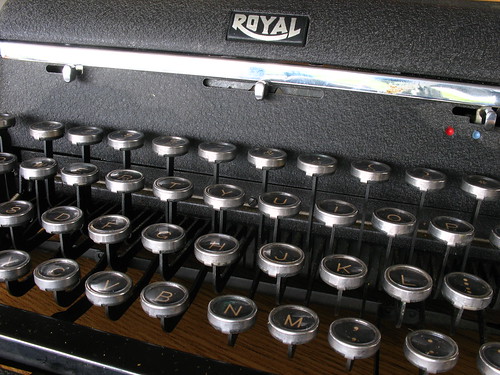
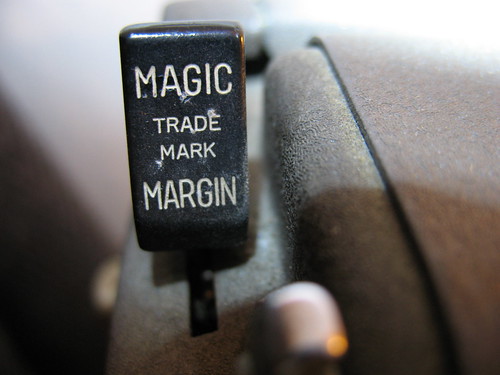
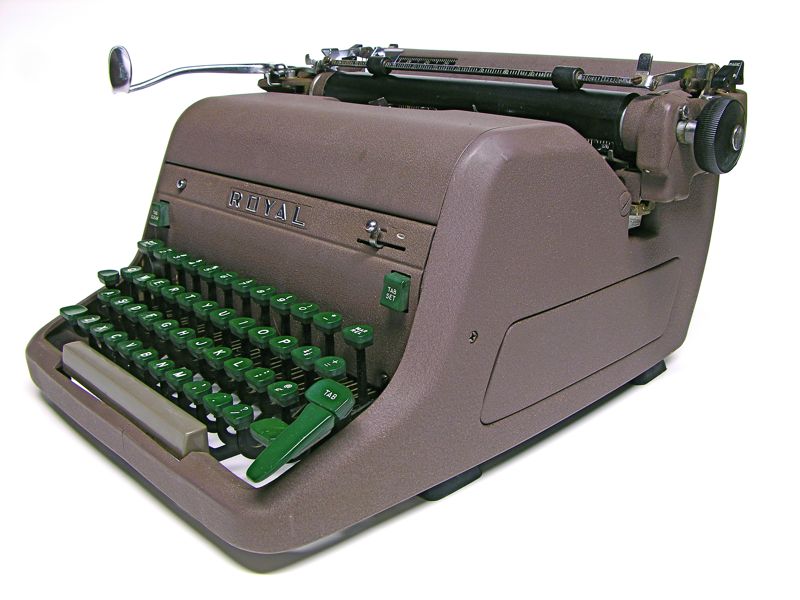
Woe to the collector who acquires their first Remington portable! Woe, I say!
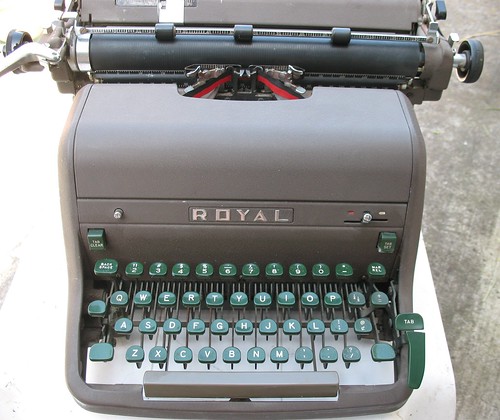
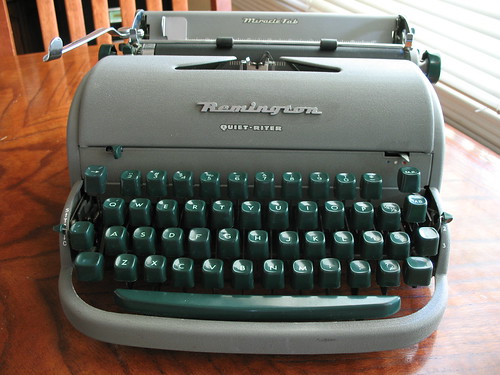 My first Remington... but not my last. A 1950s Remington Quiet-Riter
For reasons unknown to me (but probably known to others in the Typosphere), Remington eschewed using anything resembling a spool for most (or all?) of their portable machines. Sure, there were variations among other makers, too: Olivetti has spools are almost-but-not-quite like Smith-Corona, and even S-C went a different direction for their Skyriter-line ultra-portables. But, oh! Remington! You thought
Betamax vs. VHS and
PC vs. Mac was bad, but ain't seen nothin' till you find one of these banging around the inside of your new portable:
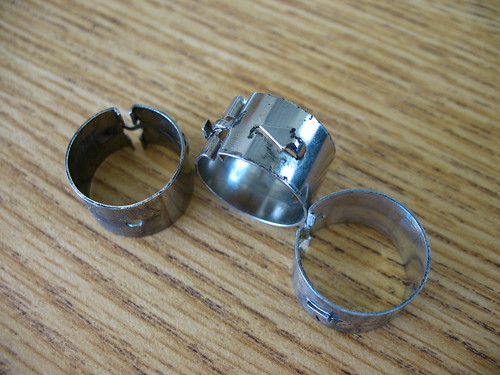 WTF?
WTF?
Seriously, Remington?
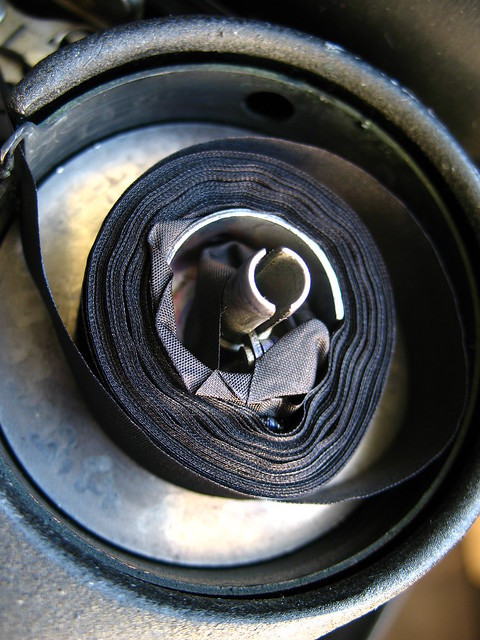
Seriously? Even in their heyday, I can't see how this system was a good idea. Remington ribbons came wound around these rings ("cores," I've seen them called) and I guess the unlucky typist just ruined her manicure by trying to drop the whole thing neatly onto the waiting platform in the machine. The core fits over the middle of the spool, and Remington machines have a permanently-attached surface that the wound ribbon rests upon, like a Lazy Susan in the middle of the table at your favorite family-style restaurant. Removing the spent ribbon must have been equally pernicious, as the poor typist would then need to pick the whole thing up and chuck it into the garbage, core and all.
What's even more shocking to me is that Remington stuck with the design, whether out of pride, or consistency, or because there was a good business case to be made by having exclusive ribbons. For the modern user/collector, though, it's a huge pain. Usually most people will start amassing a selection of spools salvaged from old machines or new plastic ones used to wind on ribbons to other machines. These are the Smith-Corona style, I think -- the 2" diameter spool with the little holes cut out near the hub which are turned by a rotating peg. I have several pairs of these, but only a few cores, despite the half-dozen or so Remingtons that have passed through my hands.
You can always wind a ribbon on to the core, of course. Slip the core over the center of the rotating platform so that the little prong points in the direction of travel, spear the end of a ribbon on that prong, and turn the platform... slowly... slowly... slowly... until it's all wound. I've done this using a pencil eraser to turn the platform like I'm punting up an inky river. The results are not pretty.
 Cover that up! Shown in a 1940s Remington Noiseless 7
Even the smallest bump or irregularity will cause the ribbon to bulge out around it. No wonder Remington put covers on top of the spools. It's just embarrassing.
Happily, there is another way. Underwood standard machines take a spool that looks a bit like a donut: the center of the spool must slip over a central hub instead of a simple peg. Whether by accident or design, this it a perfect fit in the Remington spool area. You may not be able to fit the covers over the spool afterward, but then, you may not need to.
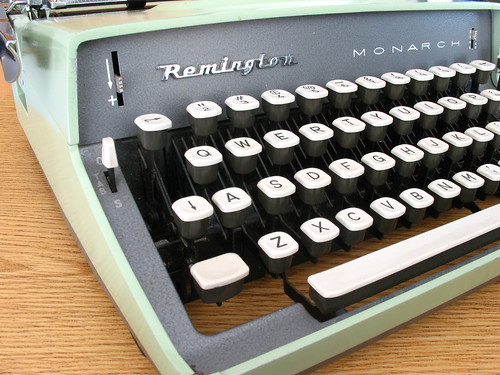
 So tidy. My OCD is sated. Shown in a 1960s Remington Monarch
The bad news is that I see these spools even less often than Remington cores: I have exactly one pair from my Underwood, and that ribbon hops around from machine to machine as needed. But at least I have the option to do this.
I have seen modern plastic "universal" ribbons for sale online that appear to have a removable central hub. The spool is black plastic, and the central hub is white. Those of you old enough to remember the adapter that fit inside 45rpm records can picture this most clearly, I think. I have yet to see one of these spools -- my local stores only carry the Smith-Corona style. If you can find some of the universal ones, though, and that center does knock out, then you won't be needlessly bitten by the Remington Curse.
Update: What brought this post on was a comment by
Judith at Dante's Wardrobe on
el Twitter as she's trying to get a ribbon onto her own Quiet Riter. She posted a photo of the innards of her machine, with something circled:

I'd forgotten about this. This is a later-style ribbon cover from Remington: it pressure fits on the central hub of the spool and can be removed with a firm pull upwards to access the ribbon and the ring/core. If you have one of these, then your spooling won't be quite as awful, since you can spin the top of the cover with your finger to wind the ribbon on. I didn't get a pair of these until I purchased
the Monarch last year, though, long after I'd acquired and sold a number of other Remingtons. If you must wind directly on, at least this can help keep your fingers from coming out totally inky. It won't make removing a dead ribbon any easier, though.