Monday, February 29, 2016

Superlative Tuesday

So I generally shy away from politics as a rule: I won't discuss them, I don't usually give my opinions on various candidates and issues, and keep my voting very close to my chest. This year's election is different-ish, for two reasons.

1) I'm not sure if it's because my child has reached voting age, or because the interconnectedness of the world has dramatically changed the landscape, or if I'm (heaven forbid) starting to finally resemble an adult, but I'm pretty excited about The Whole Process this year, to the point where I even put the primary election schedule up on our refrigerator at home. Perhaps this labels me as a Wonk, but I'm following things much more closely this year than ever in years past. I suspect, though, it's mainly because of

2) A certain candidate who has managed to evolve from harmless blowhard to punch line to actual potential candidate. I won't mention his name, but it rhymes with "rump" and "dump" and oh I can barely even joke about it. I personally skew on the liberal side of the ballot, but hey! I live near San Francisco, California after all. It's practically required. And I will admit to a certain amount of smugness in the early days of the process, as if anyone could seriously consider such a toxic, bigoted, self-absorbed, pandering egoist as He Who Shall Not Be Named. A little disarray can be healthy now and then. But what nobody counted on, I think, is the breath and strength of the disorder. The populist appeal of a demagogue in a supposedly well-connected, well-informed America. But he's playing the media like a fiddle, and the media happily dances to his tune, because it's great TV.

And somehow, inexplicably, inexcusably, he continues onward. It's no longer funny. It's become a train wreck, watching this self-inflating wind sock of a candidate flap around in whatever direction the breeze is blowing. And during those rare quiet moments, he manages to puff himself up and generate his own breeze. It's an ugly wind. It stinks. No matter what your political inclinations, it's blowing up trouble.

Now we're on the cusp of "Super Tuesday," a day when major decisions are made in several states, determining the future of many of the campaigns. I'm a little sad that California's primary is still way out on the calendar in June. There's a certain feeling of being last to the buffet line, after everything has been picked over by the rest of the country. But this year more than others, I'm despairing at the choices being left to us.

Sunday, February 21, 2016

Dimensions

For a short while, I, like so many other reckless young men, flirted with the idea of becoming a mathematician. Luckily I was pulled from the brink by a faculty advisor and an intervention by friends who weren't so fortunate. (Intro to Organic Chemistry was their downfall. I got out just in time.) Anyhow, one of the few things I took away from those fateful months -- other than the nagging sense that I used to know how to do things like find an integral, three times a week at 8:00am -- was the notion of dimension and projection. This is hopelessly mingled in my mind with the other classes I was taking at the time, including a few philosophy courses, so Professor Polt is likely to grade me on this. I'll try to get the essay done while he's still lagged from travel.

In essence, when you're losing a dimension, you're losing information. You're seeing, in essence, the shadow-of-a-thing, projected there on the cave wall, and not the Thing itself. This came up a bit in those forgotten math courses of mine, and tragically for me, in a later computer graphics course when we talked about representing three-dimensional figures on a two-dimensional screen. (This was tragic because it threw me back into linear algebra again, after I'd worked so hard to stay clean.) You lose something, of course, when you try to show a 3D ball on a 2D monitor: the "back" of the ball is gone, flattened out and masked by the "front" of the ball. After the projection, there's no going back. The information is lost.

This is a very long-winded and rambling way for me to rant about trying to copy and paste something off my tablet, which I'm actually typing this upon, with a fingertip, which was a disaster. Left on its own, a single finger is a poor substitute for all ten working together, and I genuinely do have empathy for my fellow comp-sci graduates (and math refugees) for trying to write software that can properly derive user intent from a wobbly fingertip. I certainly got to see this in action, as I watched the poor tablet sweep through menus and settings while I tried to highlight a small section of text to email to somebody. It was a UI disaster, no matter how I tried to sneak up on it.

And that's why I broke out the keyboard, and took a second to do what I wanted with minimal fuss -- each key mapped to the action it represents, not projected down into the pitiful low-res representation. It's no wonder I cling desperately to my keyboard-enabled phone, after comic text-attempts from my wife's keyless phone "Pick up egos, molt, and very from store" is her phone's shadowy projection of "eggs, milk, and bread." The ideas are flattened out by the process, and information is lost. And personally speaking, the fingertip-on-screen barrier is annoying enough that I won't try to do that again.

I wonder if this will turn us into flat-thinkers, too? I see it, to some extent, with my eldest child. He and his friends have marathon chat sessions, but they're largely photos and short bursts of video (a technology we would have loved, back in school, no matter how much information was lost.) Text and words are a dimension that single-fingers alone are poorly situated to navigate.

Wednesday, February 10, 2016

Focusish

(Subtitle: "Hey Ted, that was kind of brilliant")

So, this happened tonight:

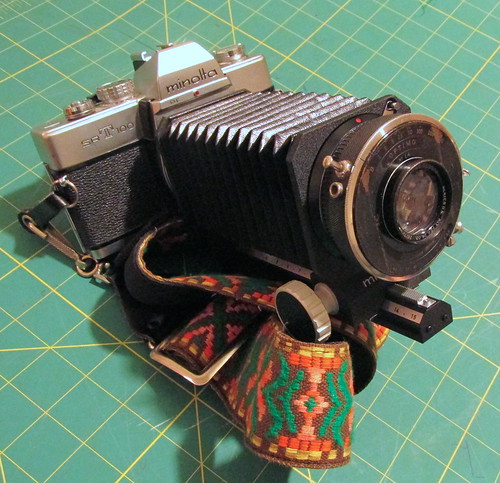
A marriage of old and new

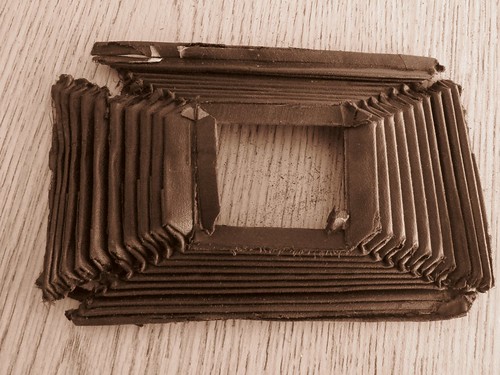
Thanks to a cheapy body cap, some short work with power tools (ooh, power tools) and an old set of macro-photography bellows that I inherited, I bring you operation "Great googly moogly, this might actually work." The bellows adjust for the long focal length of the lens perfectly.

The lens is just resting inside the hollowed-out cap at the moment, since the threaded ring that held it to the board was too large to fit inside the new mount. I'm going to look at options for this -- maybe a rubber ring to friction-fit it into place, with some tape to be extra sure? I don't want this to be a permanent attachment. And I need to get into the shutter mechanism again to figure out how to get the "T" setting working again so it doesn't require four hands to operate.

Dang. I've almost finished something I started. I may have to walk away for a year or two just to pace myself.

Wednesday, January 27, 2016

Focus

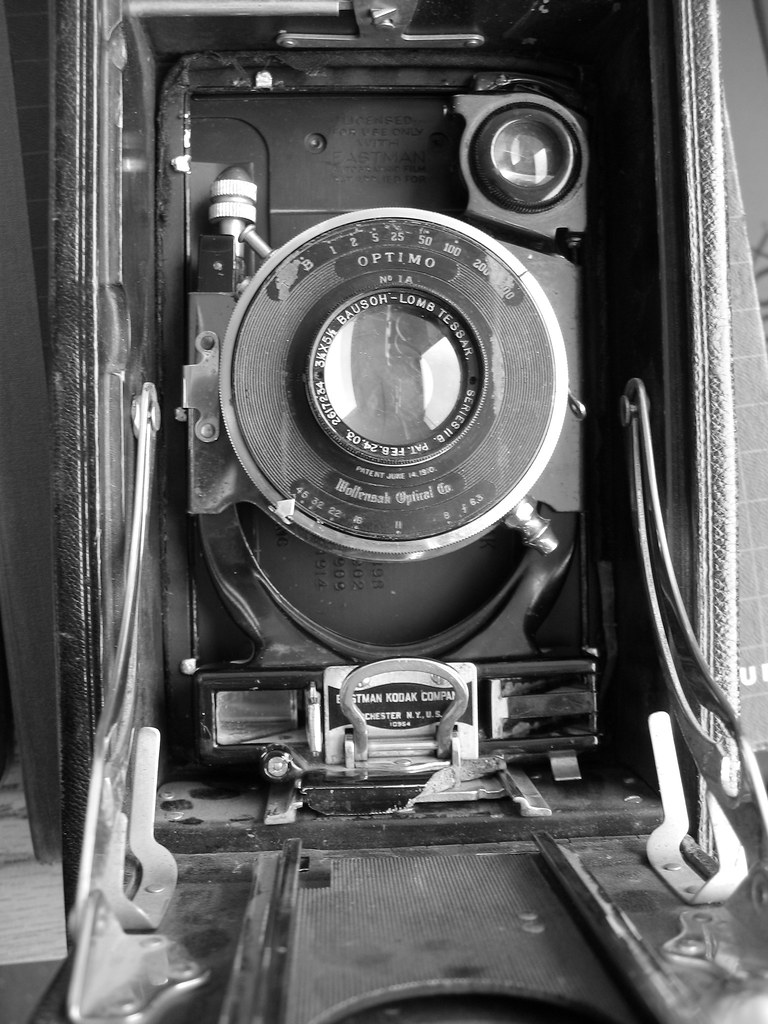
The problem with long-languishing projects left on the shelf is that eventually you need to face them. Lately I've gotten the notion to return to the old Kodak Autographic camera I picked up ages and ages ago, with the grand ambition of resurrecting it somehow. Here it is, sans bellows (see below) and with the lens board retracted.

Number 3A Special Kodak Autographic Model B

Refitting it to take modern 120 film, for example, instead of the long-defunct 122 roll film format. Replace the disintegrating bellows. And, like so many of my good intentions, the scope of the work staggered me. The "to do" list looks like:
  1. Remove lens and clean shutter
  2. Remove and replace bellows
  3. Acquire old 122 spools, somehow fit to 120 spools
  4. Hope to the spirit of George Eastman that the camera is still light-tight
  5. Take photos!

1. Remove lens and clean shutter

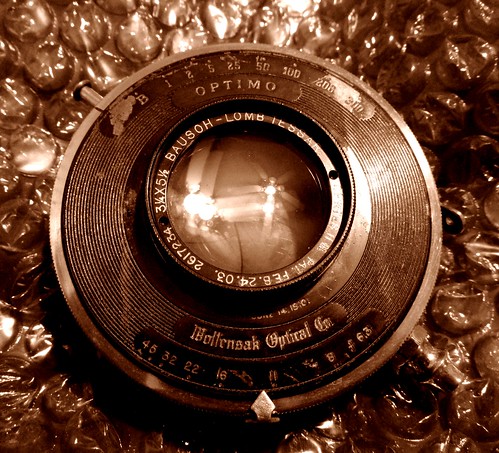
Doable enough, thanks to directions from the Net. Hey presto!

Kodak Autographic 3A Lens


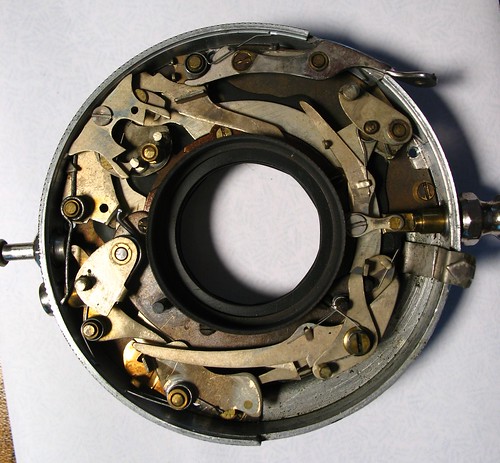
And you may remember "clean shutter" from a long-ago post. Here's the insides, if you want to marvel at it like I do:

Optimo 1A shutter mechanism

Progress: COMPLETED

2. Remove and replace bellows

Removal, check:

Kodak Autographic 3A bellows

Not surprisingly, Kodak didn't want you to remove the bellows from these cameras. Think iPhone battery, but in the 1920s.

These are were riveted into a metal plate around the lens, and are were held in place near the film by a set of menacing looking metal tabs. Oh, and they're so old and dry that they are literally crumbling.

Replacement is simple! First, build a time machine...

The collective wisdom of the Net shows DIY bellows made from leather, or light-blocking curtain fabric, or black Bristol board and duct tape. There's a lot of measuring, evidently. And creasing. And folding. And maybe even a bit of math.

Progress: FULL OF GOOD INTENTIONS IF NOT ACTUAL PROGRESS

3. Acquire old 122 spools, somehow fit to 120 spools

One of the Typosphere's own solved this problem years ago, and far more elegantly than I would have. A trip to eBay for spools and the dollar store for some sacrificial screwdrivers would do it.

Progress: SHAMELESSLY COPY, BEING SURE TO CALL IT A "TRIBUTE"

4. Hope to the spirit of George Eastman that the camera is still light-tight

[Cue sound of needle scratching across a record]

Yeah, about that.

So, aside from the century(?) old bellows having seen far better days, some previous owner mishandled this camera and dropped it right on the front corner. Part of the carriage that slides the lens forward and back is simply gone. And the rangefinder mirrors are cracked and bent. And that's only what I can see.

Replacing the bellows properly looks like a project unto itself. And for a camera that's been traumatized already, that will resist my "upgrades"... well, you can see why this got shelved.

Progress: SHIFT TO PLAN "B"


Enter Plan B

Two things have me pulling the old Kodak and its part of the shelf again, working the shutter on the lens, looking at Bristol board, and pricing black cloth tape...

First, various people shooting by bodging antique or vintage camera lenses onto the front of their DSLR cameras. The results are rather dreamy and lovely to look at, and although the integrated shutter in this lens makes it far from suitable for re-use that way, it got me thinking about the marriage of old versus new.

Second, there's (no surprise) a very vibrant DIY camera movement out there. Joe Van Cleave's examples are lovely pieces of engineering and camera-making, especially his recent box/pinhole model, which got me thinking about old view cameras, to the point where I checked out a monster coffee table book from the library just to get more inspiration. And the one that's currently giving me the most hope, as in "hey I have all that stuff at home" is this Lego-and-paper-and-tape creation.

All of these examples are helping me attain something I so badly need: focus. Not getting bogged in particulars, and remembering that it doesn't take a ton of engineering to make an image.

So, the lens is off, the bellows are destined for the trash bin, and maybe, just maybe, one project will come off the shelf.

Friday, December 18, 2015

Every Day, Carried

Feeding the Daily Beast in 2015

Yes, this again. 'Tis the season to recycle.
NaNoWriMo 2015 is now officially a Fond Memory, despite a kind of struggling finish. This year's writing basically depleted the last major deposit of story ideas in the infamous brain dump box, started so many moons ago. I suspect the plot wasn't entirely ripe yet, despite all the planning and pre-planning and post-pre-planning that went into it. Frankly, it left me a bit wrung out, but come December 1st, I kept to the vow that I made way back this summer. I've been scribbling a bit each day, refilling the notebooks if not filling up index cards, and trying to get my brain back into the low-volume-but-not-no-volume mode of being creative. My fingers are starting to itch for a return to The Ballad of Congo Willy, my oft-started, oftener-aborted NaNo 2011 win that i was working on up through September. Maybe I'll have it done by the end of the year. That would be a good thing!

The daily writing is, quite frankly, harder than I thought. Fine with the collective noise and mayhem of November, but more difficult to manage in a solo setting -- sneaking in a page or two in the evening between dinner and the kids going to bed. But a funny thing happened sometime last week: hard as it is, the writing, once started, is getting easier. And more interestingly, I think, is that I'm finding myself thinking back, way back to my first Typewriter Brigade-fueled November. That novel may be ripe for a rewrite, too. Perhaps 2016 will be the year of the rewrite? That remains to be seen.

It will be seen largely offline, though, as I am slipping towards my end-of-year holidays, time with the kids and away from the computer, time to play with pens and paper and to keep the rhino fed through the rest of the year, and, muse-willing, into the next year, too.

Merry Christmas and/or Happy Holidays, everyone!

Saturday, November 21, 2015

Suede Recap: The Nano Challenge

We're into the final ten days of NaNoWriMo, and I've been averaging around 1700 daily words, right on par for finishing on time and on target with the words. I've already had to bench a cheap nylon ribbon on account of drying out, and just now, I finished re-wrapping the platen in another sheet of suede-finish/velour-texture paper from the craft store. I've been using in it lieu of a backing sheet this year, and back before Nano got going, wrapped the platen of my main machine in tape, sticky-side-out, with a cut sheet of paper adhered to it.

The Good:
  • It's super-grippy, and seems like a quick and cheap solution to slippery worn platens. I'm running about 6-10 pages per day through the machine, and not a one of them has come through crooked. I've never had this kind of luck with a backing sheet.
  • Still an incredible bargain, especially when you coupon-stack and pick numerous replacement sheets from the craft store. Plus, it comes in zebra print which I was not quite bold enough to try (yet.) The color really dresses up the machine, which is in desperate need of it. Royal knew how to make them ugly.
The Bad:
  •  It is, fundamentally, paper, and as much as I want to pretend it's something more durable or cushioned, it's no replacement for a fresh grippy platen. The one on the Royal is a little rough from many past years in the Typewriter Brigade (this is year #8) and it's now featuring noticeable vertical banding along the rubber from all the impacts. Even with a backing sheet or two, this platen works hard.
  • Applying this is still tricky, and getting the seam flat where the ends of the paper meet requires either three hands or a better grasp of geometry. In theory, one should be able to cut right to size. In practice, I just wrapped-and-trimmed. It shows.
  • In time, my rough-and-ready tape job showed through. Not by wear in the paper, which held up admirably, but in the wrinkles from the tape surfacing on the paper itself, leading to uneven type. As in many things: take your time and take care.
The Mystery:
  • Is the fancy paper more cushioned? At least at first it seems like it is. Repeated strikes over a few weeks, though, hammered the surface into oblivion, leaving only the area outside the margins free of problems.
  • Has the platen suffered any less damage than it would without paper at all? I don't know. As I subscribe to the backing-sheet-always school of typing, I don't think it's a bad thing. It's made it over 60 years now. Any TLC is probably worthwhile.
The Photos:

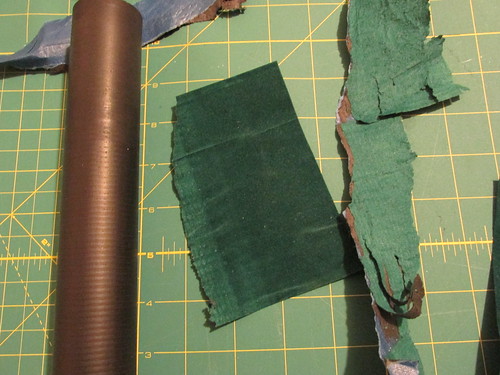
I'd hoped to peel the old sheet off somehow and have it laid next to the new one for comparison. This did not happen. Since I'd practically covered the platen in tape, the only way to remove the paper was to tear and peel in a long spiral.

Here you can see the platen on the left -- note the banding from years of typing, some of the paper on the top (the blue-tape side), and fragments that I managed to salvage. Can you tell which part of the green paper was outside the margins?

Velour-wrapped platen: unpeeled

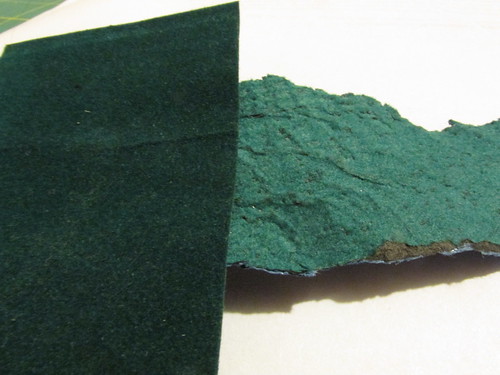
Here's another comparison of original texture versus the three-weeks-in side. You can see how bad the worn surface was wrinkled at the end. I had wrapped the platen like a barber pole in tape, spiraling down it completely.

Three weeks of daily typing took their toll

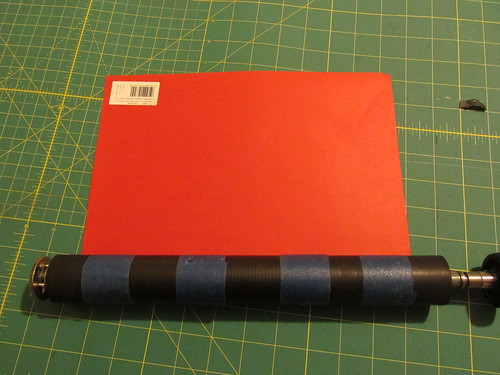
The replacement going on. I backed off on the tape this time, going for four loops instead of a complete surface. Nothing is stuck to the rubber of the platen: the tape is fastened only to itself on the ends and slides freely.

Preparing wrap #2

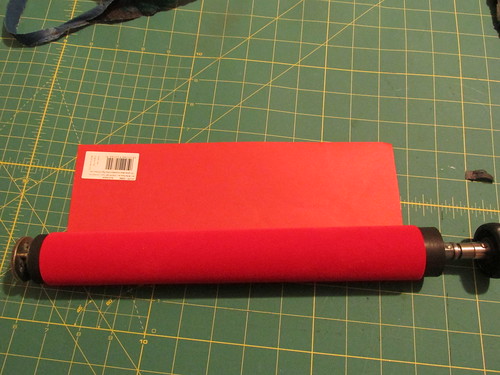
The new red wrapper, pre-trimming.

Covered in red

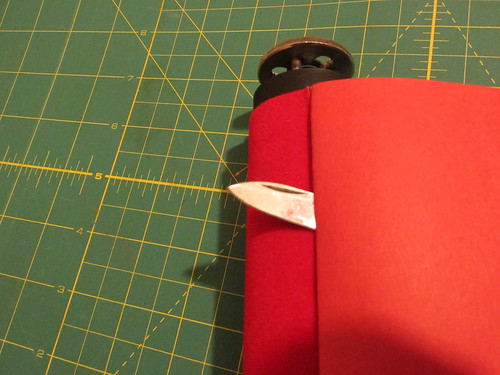
I creased along the edge where the paper meets itself, and then used a sharp pocketknife to slice down the crease to remove the excess. It's still not as good as computing the actual size or the paper needed. There's still a bit of an overlap in the final product, but it's less than my original.

Trim to fit (mostly)


This whole experiment has me looking at other sheets of material at the craft store, too -- nylon sheets, maybe actual felt instead of faux-felt... upholstery fabric? The possibilities are endless. I don't know if it has much real merit beyond short-term writing projects like Nanowrimo, or maybe the occasional photo shoot, but I'm still happy with the results.

Now, if someone just sold a wrapper that made my plot better...