Showing posts with label lucky find. Show all posts

Thursday, May 22, 2014

Reflexes, Resonance, and Focusing on Infinity

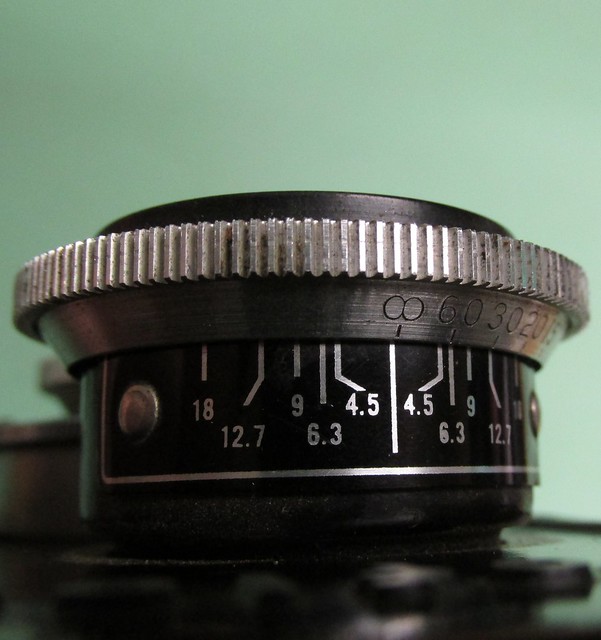
Focus on infinity
See note for photo pedants, below
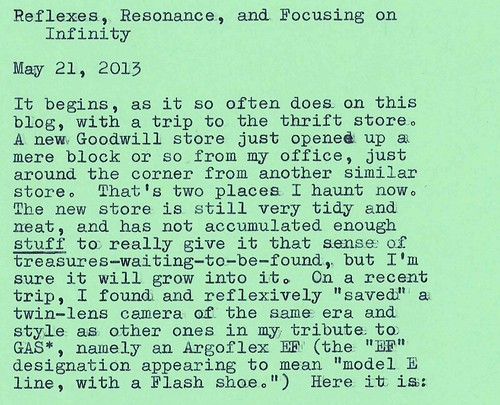
20140522 typecast pt1
* GAS = Gear Acquisition Syndrome, a plague of the camera enthusiast
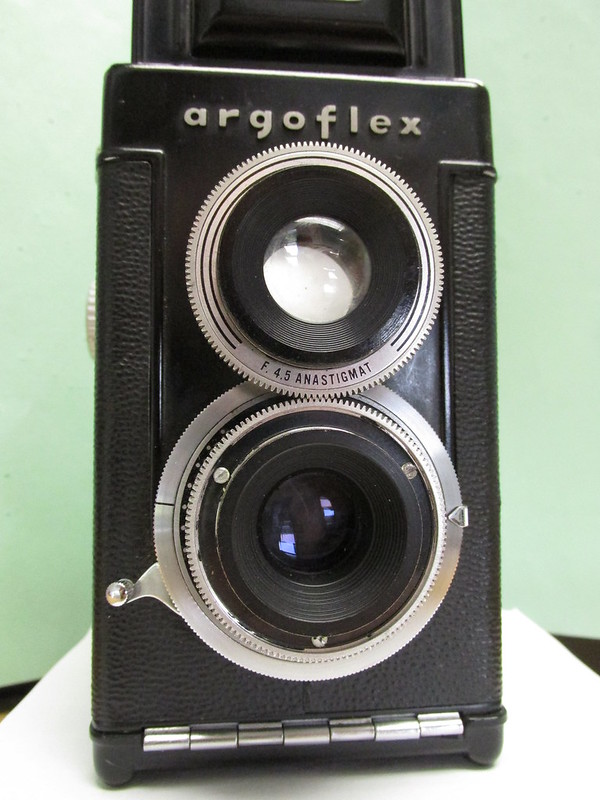
Argoflex EF

20140522 typecast pt2

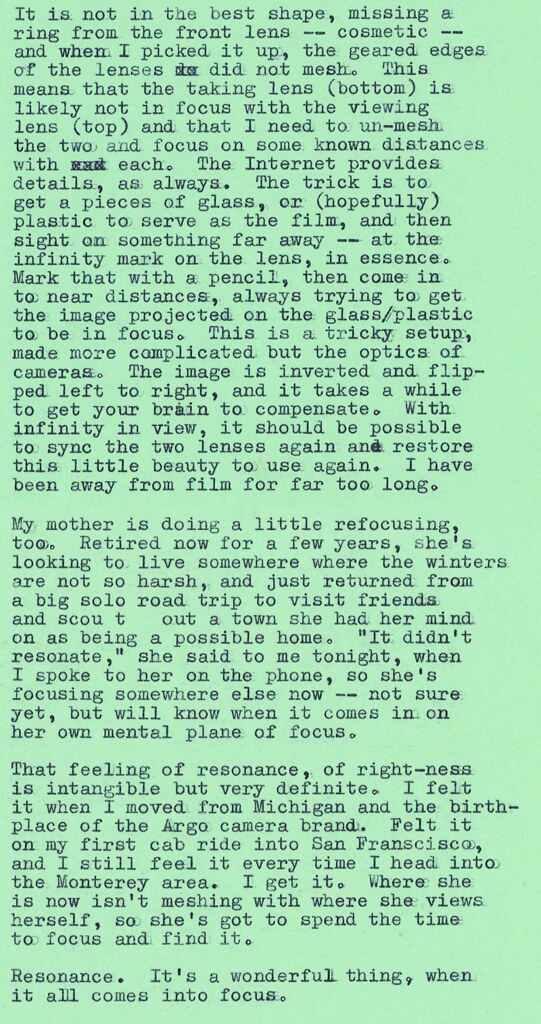
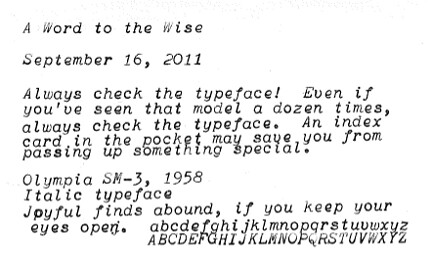
It's been far too long since I pulled out a typewriter and whipped up a typecast. I hope not to stray too far from what I consider to be the core act of a Typospherian. This was banged out on the first machine I had at hand, a locally sourced Olympia SM3. It's good to see that I have not forgotten how to make typos, though all the shadowing does tell me that I'm slow to get my hands out of the way of the keys. "Argus" is the camera brand, not "Argo" as my brain insisted. Other typo corrections are left as an exercise to the reader.

I see many of the blogs in the 'sphere are turning cameraward now. Maybe it's just because summer is approaching here in the U.S., and so one's thoughts turn naturally towards being in a dark room splashing around in cool water. The natural pungentness of the homebrew Caffenol-C developer does mean, though, that your dark room should be well-ventilated. (And while we're on the subject, ye gods do my kids look little in those old photos. Five years!)

Other photo bloggers: what are you using for fixer? Seems to me that was the only part of the process where I had to "go commercial" and just used a fixer concentrate. When that finally ran out, I set everything on the shelf again, and then evidently got busy for half a decade.

Film really is tremendous fun, and black-and-white developing is a large part of that. It's alchemy, pure and simple, turning light and microscopic silver particles into art with nothing more than coffee and soap.

The Argoflex EF (says the Internet) is a metal-bodied version of the earlier Bakelite model E and some variants. It's pretty heavy, reminiscent of the Argus C3 "brick" camera that shares the same simplicity and meshed-gear design. It's a basic design, compared to the far fiddlier -- and honestly, much nicer -- Rolleiflex cameras that I inherited from my late grandfather. I would not be afraid to take the Argoflex out to the beach, for example. It does take 620 film, but true to the Typospherian spirit, modern 120 film can be wound onto old 620 spools to fit.


Note for photo pedants: yes, I know this is not how one technically uses the infinity mark on the lens. Although this may be how one sets it for getting the focus coupling sorted out.

For those not in the know, you line up the marks on the lenses with the setting of the aperture -- the opening -- to find out the depth-of-field of your photo. Closing the aperture into a small opening allows a broad depth-of-field, or basically a photo that's in focus for a much of the distance (think landscape shots.) For sweet "bokeh" effects or to bring one area of the picture into focus, you open up the aperture and line up the marks accordingly. Aperture settings are marked in pairs on manual focus lenses. On this camera, the aperture settings are:

18 12.7 9 6.3 4.5 | 4.5 6.3 9 12.7 18

If I were set up for a real photo, that infinity mark should be lined up over one of these settings. For philosophical reasons and because the light was better :-) I put the infinity mark at the central line.

Friday, July 19, 2013

Replacement

Had it been any other machine, I would have opted either to leave it behind, or put it directly up for adoption...

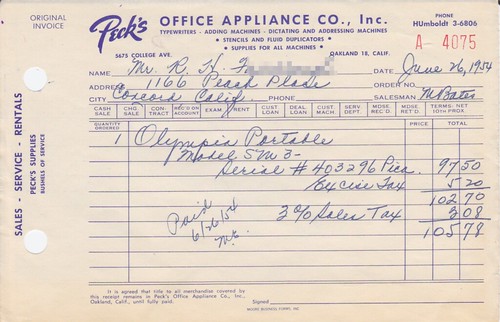
Laptop money, c. 1954

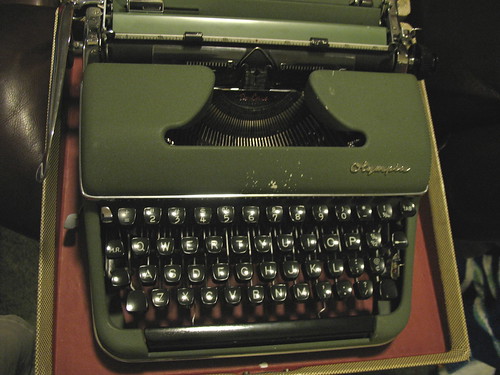
But you know, I have this weakness... for all things Olympia.

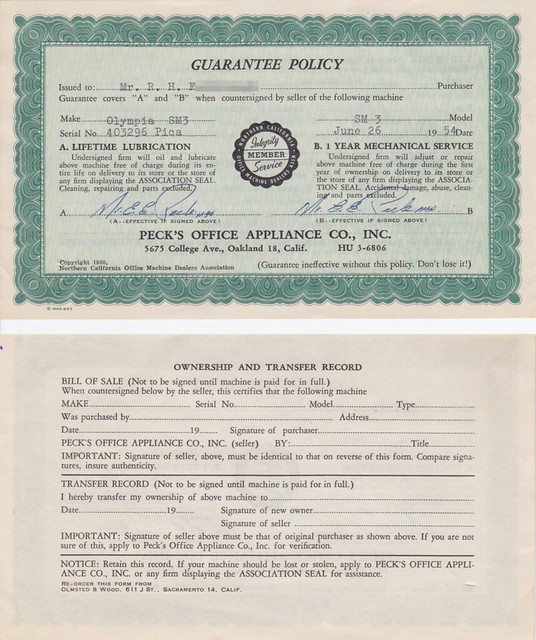
Lifetime lubrication

Especially SM3s, and extra-especially ones with a Pica typeface. I find the bigger face easier to read and edit, and it seems to scan better for me at NaNoWriMo time.

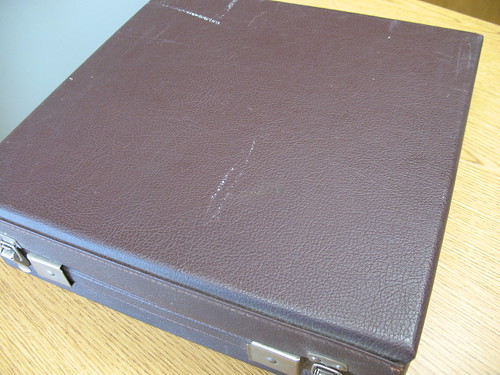
The tweedy case threw me off at first, and it was locked, so if nothing else, I had to solve the mystery. I gathered up my tiny collection of case keys (two) and hoped that one would fit so I could solve The Secret of the Anonymous Case at Goodwill. Evidently, junior sleuths the world over have nothing to fear, as closer inspection the next day revealed that someone had masking-taped the manual to the outside of the case. Tucked inside the manual, though, were the added bits of ephemeral joy scanned above: the original invoice, and the lifetime lubrication and oiling certificate, sealed by the Northern California Office Machine Dealers Association. As soon as I build that time machine, I plan to dial it back and check out one of their regional meetings.

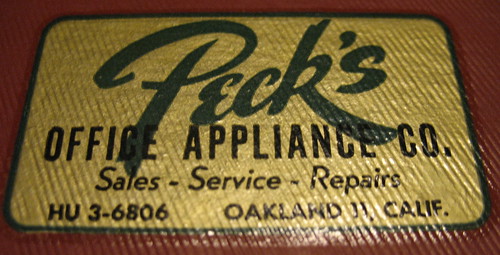
Peck's Office Appliance Company left a fine sticker inside the case which I'll have to photograph and include here. It's swag, to quote my teenager. The former site of Peck's appears to be smack in the middle of the BART line's Rockridge station, the San Francisco Bay Area Rapid Transit system: an electric elevated/subway train that is one of the major transit options around here. They're currently having a labor dispute, and we suffered from a strike back at the beginning of the summer that led to serious traffic headaches. They're still battling it out, leaving everyone scrambling for alternate ways to get around.


View Larger Map

That's something we don't really think about as commuters: the homes and businesses that were replaced by our transit system. It really only comes to mind in a few places along the line, as the tracks skirt close to a crumbling property or appears in the narrow buffer between streets. Rockridge was one of the stops on the line that I rode for years in and out of San Francisco. BART opened in the 1970s, and was a fixture out in the suburbs by the time I moved to California twenty-five or so years later. Rockridge station opened up in 1973, says Wikipedia, just nineteen years after this typewriter was sold. I don't know how long Peck's held on after that, but I don't think I'll be able to cash in on that "Lifetime Lubrication" offer any time soon.

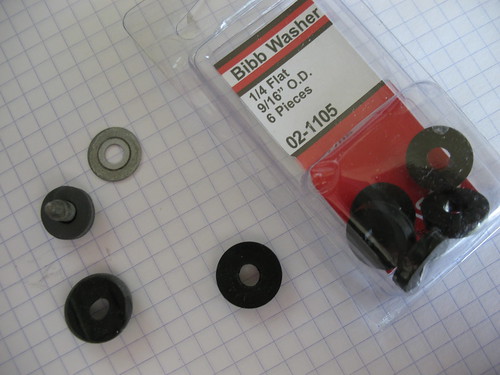
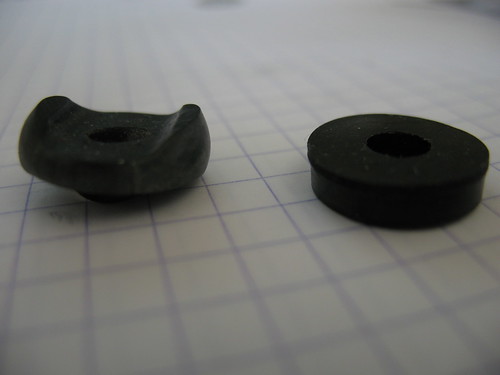
Like all good Olys, this one needs the standard bushing replacement surgery. It's no big deal: I'm familiar with the process now, and know exactly where to go in the hardware store for the replacement parts.

Broken typewriter? Call a plumber

Replacing a set of crushed and fossilized bushings hardly warrants a mention...

Smushed

What this does mean, though, is that one of the other machines is now up for adoption. After some soul-searching, I've put up a Smith-Corona Sterling that's basically sat idle since it came in on a swap from Olivander of Machines of Loving Grace fame. It, along with the other machines, are up on a new dedicated "adoption" page. This might be the best way for me to deal with the thrill of the hunt, without the space considerations of the "trophies": find 'em, fix em, find new homes for 'em. Sometimes replacement is the only way.

UPDATE: the lighting couldn't be much worse for these. Anyone know a secret for getting White-Out out of crinkle paint? (At least I hope it's White-Out) 

Olympia SM3, c.1954

Ted's database says 1953 for serial number 403296. Sounds about right to me.

Peck's Sticker

Golden label with green lettering, just about the same as the paint color. Stylin'! I wouldn't mind this being on the machine itself, but it's discreetly tucked inside the case lid.

Wednesday, June 27, 2012

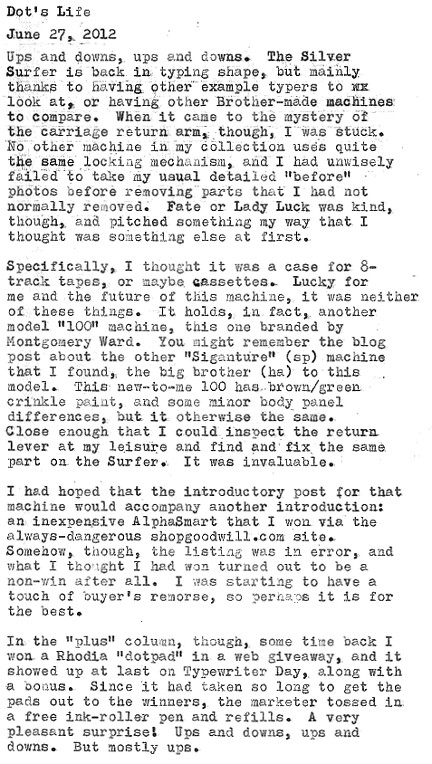
Dot's Life

typecast 20120627

What could it be?
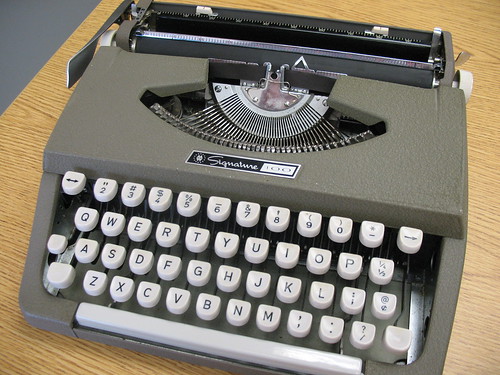
Finding the Signature 100 in the wild (recreation)

Signature 100 Typewriter
Surprise! It's a typewriter. Never expected to see that around here, did you?

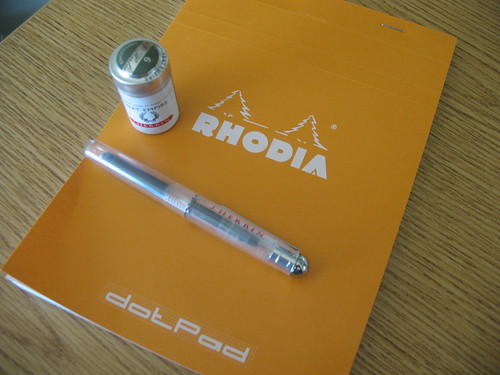
Rhodia goodies
Something unexpected (but not at all unwelcome)


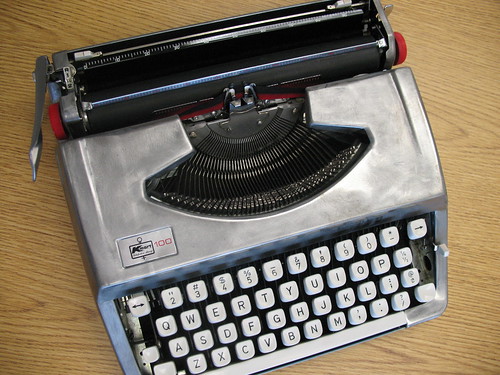
Typed on the recently Silver Surfer-ized Kmart 100
The Silver Surfer, complete

Friday, January 20, 2012

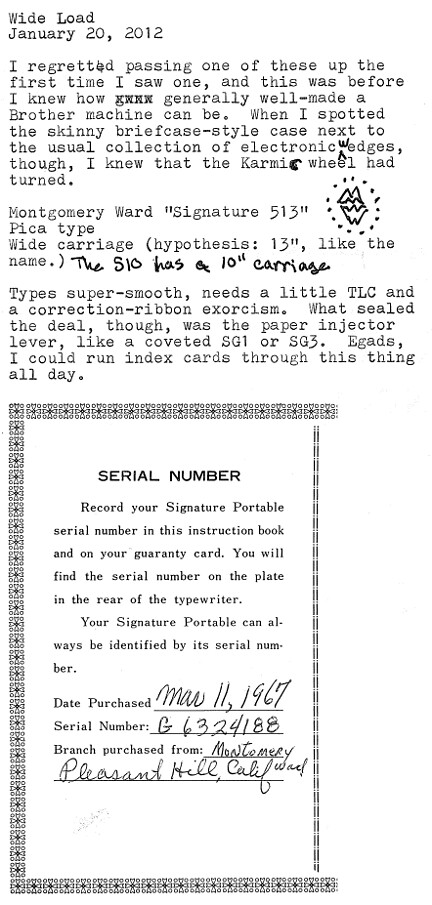
Wide Load

20120120 typecast

Speaking of depreciation, the price I paid for this (in 2010 dollars) equates to $0.93 in 1967 dollars, roughly the price of a pound of ground coffee in the supermarket. This machine stayed local, as you can see from the owner's notes. Interestingly, our dining room table and living room furniture in our current home came from the same store, about 30 years later, just a handful of years before "Monkey Ward" disappeared entirely.

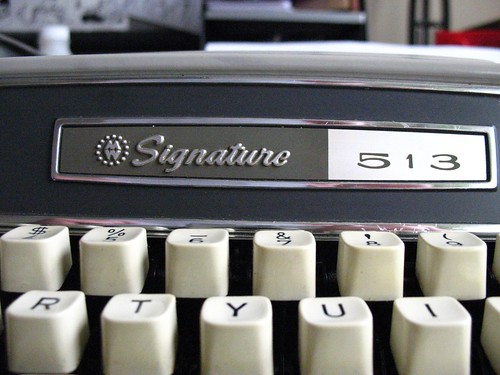
Teaser photo: test-typed on a Montgomery Ward Signature 513 (made by Brother)
Beige and Chrome

Tuesday, May 18, 2010

Hip at Last?

...or midlife crisis? Or lucky coincidence? Probably more of the latter. I stumbled into an original Polaroid SX70 yesterday completely unexpectedly and grabbed it if only for he eBay potential. I still have a few boxes of the expired film stash that I found last year, although it's the wrong speed for this camera, it can be made to fit, and after a failed test shot, I managed a blurry one of one of the flowering bushes in our yard:

Bottlebrush Plant

Overexposure and old film makes it hard to pick out what you're seeing: here's a black-and-white conversion of the same shot:

Bottlebrush Plant (b&w conversion)

The SX70 is desirable among the hipster crowd, possibly because it's one of the few Polaroid cameras that is a "reflex" model: that is, when you look through the viewfinder, a set of mirrors and lenses is letting you peek through the actual lens, allowing a fine degree of focus -- much finer than the rainbow-striped "One Step" or "The Button" models that it seems like everyone had in the 70's and 80's. It's a cool little camera, and while trying to figure out how to fit the wrong film inside* I found this pretty-awesome version of the old SX70 ad with "Garbageman" by The Cramps overlaid:


(caution: may cause unexplained rocking out)

Turns out the original video was directed by the infamous Eames brothers, best-known to me of the creators of the Eames Lounge Chair, which was the chair of choice of my late photography-nut grandfather. The Eames name has become a shorthand to mean "mid-century design" and has a certain degree of hipness to it as well.

Suddenly I'm cool all over the place.


* The 600 film packs have little nubs on the bottom that get caught up in a tensioning spring in the SX70. You can use a playing card wedged under the film to make a little ramp as you slide it in, then remove the card to seat it properly. 600 film is faster than the original SX70 film, and there are instructions in the nets about using filters to trick the SX70 sensors into compensating, though it's not strictly necessary.